[태그:] 8-bit

  • Why NES Cartridges Are Twice as Big as Famicom Games (It’s Not Extra Memory)

    If you grew up blowing into a gray Game Pak in the living room, a Japanese Famicom cart looks almost like a toy from another planet. It’s smaller. It’s often red, cream, or bright plastic instead of that industrial gray. And it will not slide into an American NES. Not even close.

    Same family of hardware. Completely different plastic. That mismatch was not an accident. After the North American video game crash of 1983, Nintendo rebuilt the Japanese Family Computer for U.S. living rooms — and the cartridge was part of the disguise.

    The Short Answer

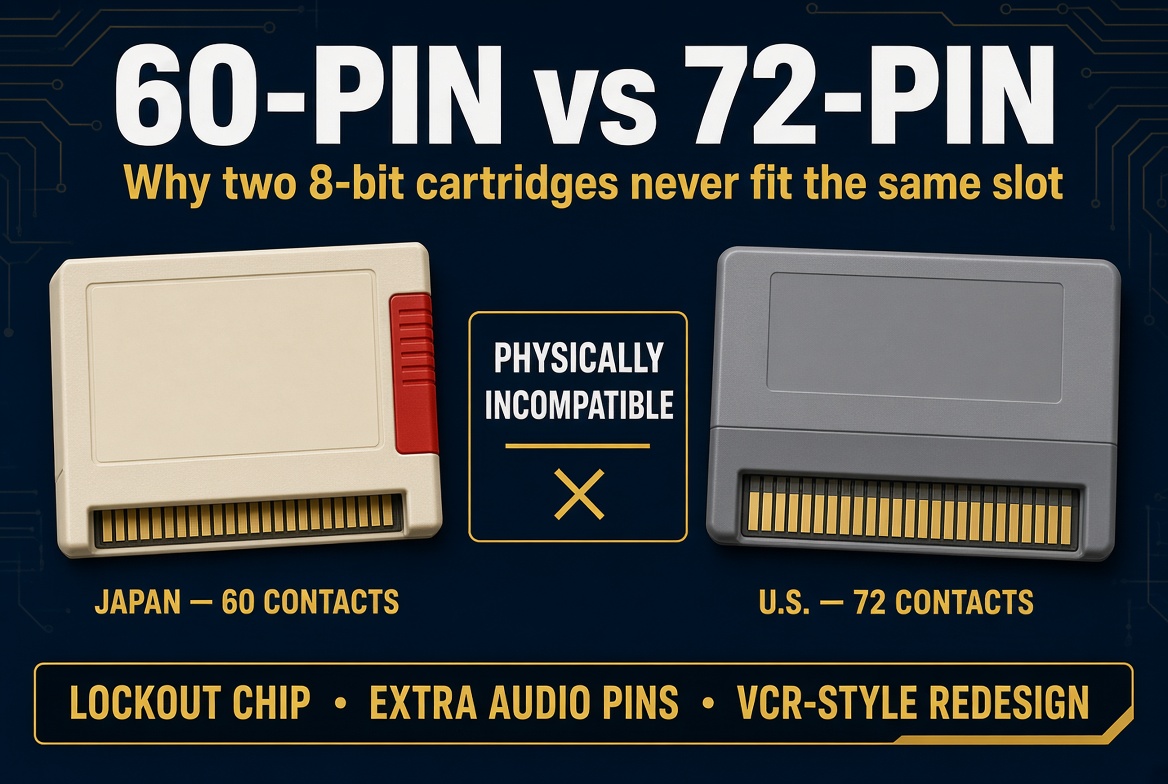
    The Japanese Famicom (1983) uses a 60-pin cartridge. The North American NES (1985) uses a 72-pin Game Pak. Twelve extra contacts, a larger shell, a front-loading “VCR” slot, and a lockout chip sit between them. Software can be the same game. The connector is not.

    Typical sizes:

    • Famicom cart: about 10.8 × 6.9 cm (roughly 4.25 × 2.75 in)
    • NES Game Pak: about 13.3 × 12 cm (roughly 5.25 × 4.75 in)

    The extra plastic is mostly empty space. It does not mean more ROM. It means a different marketing plan and a different electrical contract.

    Nintendo Didn’t Bring the Famicom to America. It Brought a “Control Deck.”

    In Japan, the Famicom looked like what it was: a colorful home toy with hardwired controllers and a top-loading slot. In 1985 that look was poison in U.S. retail. Atari had just burned the market. Store buyers did not want another “video game console” gathering dust next to the closeout bins.

    Nintendo of America’s answer was theater:

    • Call it the Nintendo Entertainment System, not a game console
    • Call the cart a Game Pak
    • Call the box a Control Deck
    • Load software from the front, like a VHS tape
    • Bundle R.O.B. the robot so the thing looked like a science kit, not a toy that already failed

    A tiny, candy-colored Japanese cart would have given the game away. A big gray slab that disappeared into a front slot looked like home electronics. Kids still knew what it was. Parents and buyers got cover.

    That front-loader is also why so many American kids spent the ’90s blowing into cartridges. The zero-insertion-force connector bent and oxidized. The later top-loading NES-101 quietly admitted the original slot was a bad idea.

    What Those Extra 12 Pins Actually Do

    This is the part most “region lock” explainers skip.

    The two systems share the important buses: CPU address/data, PPU address/data, power, ground, and control lines. The pinout is similar, almost a mirror in places. The extras are political and architectural.

    On the NES (72-pin), Nintendo added:

    • CIC / 10NES lockout pins — a handshake chip in the console and another in the cart. If they don’t talk, the deck reset-loops. That is how Nintendo enforced the Official Seal and blocked unlicensed carts in North America. The original Famicom has no CIC.
    • Expansion-port pins — ten contacts that pass through to the unused connector on the bottom of the NES. The port was planned for add-ons that never became a real U.S. ecosystem.

    On the Famicom (60-pin), Nintendo kept something the NES later removed from the cart slot:

    • Two audio mix pins. A cartridge (or the Famicom Disk System) can inject extra sound chips into the console’s analog mix. When the NES was redesigned, those pins left the Game Pak connector and moved to the bottom expansion port. A stock NES cart cannot add those channels.

    Net result: the American cart gained a cop and lost a mixing board.

    Why Japanese Soundtracks Sometimes Hit Harder

    If you have ever compared the Japanese and U.S. versions of late-era 8-bit games, the American mix can feel thinner. That is not nostalgia. It is missing silicon.

    Konami’s Japanese Akumajō Densetsu (the Famicom Castlevania III) uses a VRC6 chip for extra pulse and sawtooth voices. The U.S. release had to live without that cartridge audio path, so the arrangement changed. Similar cuts hit other Famicom titles that mixed mapper sound into the RF/AV output.

    An adapter that only remaps pins will boot the game. It will not automatically restore those extra voices on an unmodified front-loading NES. That requires the adapter to pass the audio pin and a console-side mix back into the audio path.

    Nintendo Already Shipped a Converter — Inside Launch Games

    Here is the collector trivia that still surprises people.

    In 1985, Nintendo did not have enough 72-pin boards ready for the U.S. launch. So some early American Game Paks — Gyromite is the famous one — hide a 60-pin Famicom PCB plus an internal 60-to-72 converter inside the gray shell. Same game, leftover Japanese board, secret adapter.

    How hunters spot them without cracking the case:

    • Heavier cart (about 4.5–4.7 oz vs. ~3.8 oz)
    • Early 5-screw shells
    • Gold contacts that are not perfectly symmetrical

    Nintendo did this to ship on time and reuse inventory. The company that locked the pinout also proved the two boards were electrically close enough to adapt.

    Cartridge Converters in 2026: What You Actually Need

    There are two directions. They are not the same product.

    1. Famicom cart → NES console (60-to-72)

    You drop a Japanese cart into a pass-through adapter, then insert that sandwich into an NES or NES-compatible deck. This is the common U.S. collector setup.

    What usually works: most standard mapper games, sports titles, platformers, early licensed software.

    What often fails or degrades:

    • Games that need expansion audio (unless the adapter and console are both wired for it)
    • Some MMC5 and late custom-mapper titles
    • Extra-tall Famicom shells that physically will not seat in a cheap adapter
    • Front-loading NES CIC quirks: some cheap adapters need a few Reset presses, or they fight the lockout chip

    Name-brand pass-throughs (Hyperkin and similar) are the “good enough” option for casual play. Quality varies a lot on generic marketplace adapters. Fit, pin spring tension, and whether audio pins are even routed are the three things that separate a $12 paperweight from a daily driver.

    2. NES cart → Famicom console (72-to-60)

    Less common in the States, essential if you own an original Famicom or AV Famicom and a pile of gray Game Paks. These adapters hang off the smaller Japanese slot. Build quality matters even more because the Famicom slot is short and the NES cart is heavy.

    MMC5 support and M2 signal integrity are the usual weak points. Enthusiasts sometimes add a small resistor or capacitor on M2 to stop lockups. That is hobbyist territory, not a living-room accessory.

    3. The “better than an adapter” options

    • Top-loading NES-101: no CIC on many units, friendlier slot, still 72-pin. Adapters fit more cleanly than in a tired toaster NES.
    • AV Famicom: 60-pin, composite out, the grown-up Japanese deck. Best home for real Famicom carts.
    • Licensed flash carts (EverDrive N8 and peers): separate NES and Famicom editions exist. The Famicom edition is the clean way to hear expansion audio on original Japanese hardware. Do not treat this as a green light to load dumps you do not own. AdSense and copyright law both care about that line.

    Adapter Reality Check (Save This Before You Buy)

    GoalRealistic setup
    Play a few imported Famicom carts on a U.S. NES60-to-72 pass-through + working front-loader or top-loader
    Hear the extra Japanese soundtrackAdapter that routes audio and an NES audio mix mod, or play on a Famicom / flash cart made for Famicom
    Play U.S. Game Paks on a Famicom72-to-60 adapter with solid MMC5/M2 behavior
    Avoid hardware dramaBuy the matching region console for the library you actually own

    An adapter is a pin translator. It is not a region-free magic brick. Language, mapper chips, CIC handshake, and analog audio are separate problems.

    Why Nintendo Split the Format on Purpose

    Three motives stacked on top of each other:

    1. Retail camouflage. After 1983, the U.S. product had to look like consumer electronics, not a failed toy category. Bigger, uniform gray Paks and a front slot sold that story.
    2. License control. Japan already had a flood of weak third-party Famicom software. For America, the CIC made unlicensed carts a hardware problem, not just a legal letter. Nintendo manufactured the Game Paks. Publishers paid the tax. The Seal of Quality became a business model.
    3. Future-proofing the shell, not the connector. The huge American case left room for bigger boards and extra chips. Most licensed games never needed that volume. The empty plastic still made boxes look expensive on a Toys “R” Us shelf.

    Japan kept colored shells, publisher-specific shapes, a microphone on controller 2, and those audio pins. America got detachable controllers, composite video on later decks, and a lock.

    Same CPU family. Different contract with the living room.

    FAQ

    Can I force a Famicom cart into an NES?
    No. Different width, different pin count, different keying. You will damage the connector.

    Are the games the same ROM?
    Often yes at the program level, with localization and mapper/audio changes. The board and shell are not interchangeable.

    Will every Famicom game boot on a cheap Amazon adapter?
    No. Test reports matter. Tall carts, MMC5, and expansion-audio titles are the usual break points.

    Is the lockout chip why my NES blinks?
    Often. Dirty pins, a bent front-loader, or a cart/adapter the CIC does not like will sit in a reset loop. The top-loader generation dropped that fight.

    Did Europe use the same cart as the U.S.?
    PAL NES Game Paks use the same 72-pin family as North America, with video-timing and CIC-key differences. They still do not accept 60-pin Famicom carts.

    Bottom Line

    The NES and Famicom are cousins, not twins. Nintendo changed the cartridge because it was redesigning the product category for a country that had just sworn off video games. Sixty pins became seventy-two so a lockout chip could live on the cart, extra audio could be moved off it, and a gray slab could impersonate a videotape.

    If you collect both libraries, buy the matching deck or a known-good converter — and treat expansion audio as a separate project, not a free bonus. The plastic was the policy.