[태그:] DSP-1

  • The Secret Weapon of 16-Bit Gaming: SNES Enhancement Chips and Their Iconic Games

    Introduction: The Hidden Power Inside SNES Cartridges

    During the height of the 16-bit console war between Nintendo and Sega in the early 1990s, the Super Nintendo Entertainment System (SNES)—known in Japan as the Super Famicom—boasted rich color palettes, hardware-level sprite scaling, and legendary sound sampling capabilities.

    However, as game developers pushed the boundaries of interactive design, the base console’s Central Processing Unit (a 16-bit Ricoh 5A22 running at a modest 3.58 MHz) began encountering hardware bottlenecks.

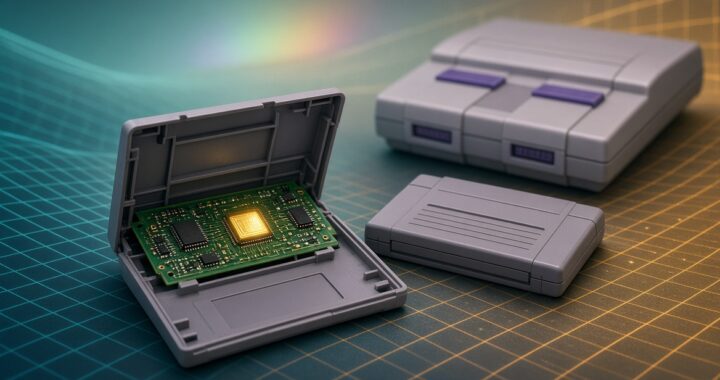
    Rather than releasing an entirely new home console, Nintendo and visionary third-party developers conceived an ingenious solution: cartridge-based enhancement chips.

    By embedding specialized coprocessors directly inside individual game cartridges, Nintendo effectively upgraded the console’s computing power on a game-by-game basis. These custom microchips handled advanced 3D polygon rendering, complex sprite math, rapid decompression, and real-time encryption.

    For modern retro collectors and gaming historians, understanding these enhancement chips reveals how the SNES managed to rival the early 32-bit era. Here is your ultimate guide to the specialized chips that powered the greatest games on the Super Nintendo.

    1. The Super FX Chip (GSU): The Birth of Console 3D Polygon Rendering

    Perhaps the most famous enhancement chip in 16-bit history is the Super FX (later upgraded to the Super FX 2 / GSU-2). Co-developed by Argonaut Software and Nintendo, the Super FX was a custom RISC processor mounted directly onto the cartridge PCB.

    How It Worked

    The stock SNES architecture was designed primarily for 2D tile-mapped graphics. The Super FX chip took over the heavy mathematical lifting required to calculate 3D geometric math, rendering textured 3D polygons directly into the console’s frame buffer.

    Iconic Super FX Games

    • Star Fox (1993): The landmark title that demonstrated real-time 3D polygon flight simulation on a 16-bit home console. Without the Super FX chip, the intense dogfights through Corneria would have been technically impossible.
    • Stunt Race FX (1994): A full 3D racing game featuring cartoonish poly-vehicles, dynamic camera angles, and deformable courses.
    • Super Mario World 2: Yoshi’s Island (1995): Used the upgraded Super FX 2 chip not for 3D graphics, but to perform complex 2D sprite manipulation—such as dynamic sprite rotation, scaling, and massive boss transformations (e.g., Baby Bowser).
    • Doom (1995): Sculpted a custom 3D environment to bring id Software’s iconic PC shooter to the SNES using a custom 21.7 MHz Super FX 2 chip.

    2. The SA-1 (Super Accelerator 1): Pure 16-Bit Muscle

    Released in 1995, the SA-1 (Super Accelerator 1) was essentially an upgraded, higher-speed version of the console’s primary Ricoh 5A22 CPU, operating at an impressive 10.74 MHz (three times faster than the native SNES CPU).

    Key Technical Advantages

    • Elimination of Slowdown: The SA-1 allowed games with hundreds of moving sprites and complex collision physics to run flawlessly without frame rate drops.
    • Fast RAM Access & Hardware Math Engines: Provided instantaneous memory mapping, bit-plane conversions, and hardware-accelerated multiplication and division.

    Notable SA-1 Games

    • Super Mario RPG: Legend of the Seven Stars (1996): Square’s isometric masterpiece relied heavily on the SA-1 to execute pre-rendered 3D characters, intricate battle mechanics, and smooth environmental animations.
    • Kirby Super Star (1996) & Kirby’s Dream Land 3 (1997): Utilized the SA-1 for fast-paced mini-games, complex AI behavior, and vivid multi-layered background parallax.
    • PGA Tour 96 (1996): Used the chip to quickly calculate terrain physics and render golf course landscapes in real-time.

    3. The DSP Series: Math Engines for Mode 7 and Scaling

    Before full 3D processors like the Super FX were developed, Nintendo created the Digital Signal Processor (DSP) series to assist with complex vector math, trigonometry, and pseudo-3D perspective mapping.

    DSP-1: The Mode 7 Enhancer

    The DSP-1 (and its sub-variants 1A and 1B) was the most widely used DSP chip, designed to perform fast floating-point calculations for games utilizing the console’s built-in Mode 7 rotation and scaling effects.

    • Super Mario Kart (1992): Used the DSP-1 to constantly calculate track perspective shifts, wall collisions, and split-screen multiplayer positioning in real-time.
    • Pilotwings (1991): Relied on the DSP-1 to calculate flight vector trajectory and ground-perspective scaling as players parachuted or glided through 3D space.

    DSP-2, DSP-3, and DSP-4 Variants

    • Dungeon Master (1993 – DSP-2): Accelerated vector math for real-time 3D dungeon crawling.
    • SD Gundam GX (1994 – DSP-3): Assisted with turn-based strategy AI logic and battle screen calculations.
    • Top Gear 3000 (1995 – DSP-4): Calculated split-screen racetrack rendering and warp-gate trajectory paths.

    4. Capcom’s Cx4: Trigonometry for 2D Wireframes

    Capcom preferred to design its own proprietary coprocessor to elevate its marquee action titles. The result was the Capcom Cx4, a mathematical coprocessor dedicated to calculating trigonometric operations and wireframe 3D rendering.

    Famous Cx4 Games

    • Mega Man X2 (1994): Featured smooth wireframe 3D boss models (such as the giant computer head in the opening stage and Wire Sponge’s vines) and rotating background elements.
    • Mega Man X3 (1995): Expanded the chip’s usage to render complex boss animations, vector-based lighting effects, and multi-stage cutscenes.

    5. Decompression Chips: S-DD1 and SPC7110

    Toward the end of the 16-bit era, game worlds became vastly larger, threatening to exceed the standard memory limits of standard ROM chips. Manufacturing massive 48-Megabit or 64-Megabit ROM chips was prohibitively expensive, so developers turned to real-time data decompression chips.

    The S-DD1 (Super Direct Decompression 1)

    Designed by Nintendo and Capcom, the S-DD1 compressed graphic assets directly on the ROM. When the console requested graphic data, the S-DD1 decompressed sprite data on-the-fly, streaming it directly to the video display processor.

    • Street Fighter Alpha 2 (1996): Compressed high-fidelity arcade sprite frames into a 32-Megabit cartridge format, bringing arcade-accurate animation frames home without long loading screens.
    • Star Ocean (1996): Compressed massive hand-drawn background art, dynamic sound clips, and extensive voice acting into a single Super Famicom cartridge.

    The SPC7110 Decompression Chip

    Used exclusively by Hudson Soft, this chip performed similar high-speed decompression and featured a real-time clock (RTC) circuit.

    • Far East of Eden: Zero (Tengai Makyou Zero) (1995): Used the SPC7110 and internal battery clock to sync real-world calendar events, day/night cycles, and seasonal festivals inside the game world.

    Summary Table: SNES Enhancement Chips & Notable Titles

    Enhancement ChipPrimary FunctionFamous Representative Games
    Super FX / FX 23D Polygon Rendering & 2D Sprite ScalingStar Fox, Yoshi’s Island, Doom
    SA-110.74 MHz CPU Acceleration & Memory MappingSuper Mario RPG, Kirby Super Star
    DSP-1Trigonometry & Mode 7 Perspective MathSuper Mario Kart, Pilotwings
    Cx42D Vector Rotation & Wireframe MathMega Man X2, Mega Man X3
    S-DD1On-the-Fly Graphics DecompressionStreet Fighter Alpha 2, Star Ocean

    Conclusion: The Legacy of SNES Coprocessors

    Nintendo’s decision to put specialized enhancement chips inside individual cartridges was a masterclass in hardware engineering. By offloading complex mathematical algorithms, 3D rendering, and real-time decompression to peripheral hardware, the SNES continually evolved throughout its seven-year primary lifespan.

    These coprocessors allowed a 16-bit console from 1990 to stand toe-to-toe with newer 32-bit platforms, producing some of the most memorable visual and mechanical achievements in interactive entertainment history.

    Frequently Asked Questions (FAQ)

    Q1: Do SNES enhancement chips affect modern emulation or flash carts?

    Yes. Because these chips are physical hardware processors, early emulators and budget flash carts struggled to play them. Modern high-end FPGA systems (like the Analogue Super Nt) and advanced flash carts (like the FXPak Pro) physically emulate these coprocessors using onboard FPGA logic to ensure 100% compatibility.

    Q2: Which SNES chip was the most powerful?

    In terms of raw processing speed and versatility, the SA-1 (operating at 10.74 MHz) and the Super FX 2 (operating at 21.7 MHz) offered the highest computing horsepower on the platform.

    Community Discussion

    Which SNES enhancement chip game impressed you the most back in the 1990s? Do you prefer the polygon wizardry of Star Fox or the buttery-smooth performance of Super Mario RPG? Let us know in the comments below!