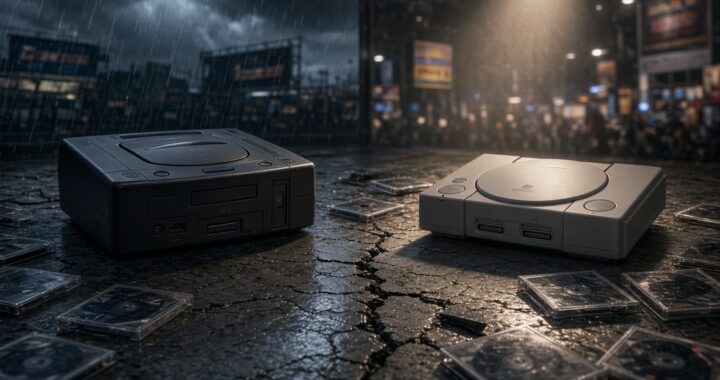
[태그:] E3 1995 Surprise Launch

  • The Tragedy of 1995: How the Sega Saturn Fought the Original PlayStation

    Introduction: The Dawn of the 32-Bit Console War

    In the mid-1990s, the video game industry was teetering on the edge of a massive generational shift. The 16-bit era, dominated by the fierce rivalry between the Sega Genesis and the Super Nintendo (SNES), was drawing to a close. As players demanded full-motion video, CD-quality audio, and real-time 3D environments, the stage was set for the 32-bit era.

    Fresh off the massive North American success of the Genesis, Sega of America felt poised to dominate the next generation. Their weapon of choice was the Sega Saturn—a powerhouse system engineered with state-of-the-art arcade hardware in mind.

    However, when the Saturn arrived in North America in May 1995, it encountered an unexpected juggernaut: Sony’s newcomer, the PlayStation (PS1).

    What followed was one of the most infamous marketing battles in interactive entertainment history—a story of corporate hubris, brilliant Japanese arcade engineering, architecture challenges, and an enduring cult legacy.

    Here is the complete history of how the Sega Saturn attempted to stand against the Sony PlayStation.

    1. The E3 1995 Debacle: A Surprise Launch Gone Wrong

    The rivalry between the Sega Saturn and the Sony PlayStation was forever defined by a single day: May 11, 1995, at the inaugural Electronic Entertainment Expo (E3) in Los Angeles.

    +--------------------------------------------------------------------------+
    | THE E3 1995 SHOWDOWN                                                     |
    | Sega Saturn:  Surprise Launch Today | $399 Price Tag | Limited Retailers |
    | Sony PS1:     Launching Sept 9th   | $299 Price Tag | Mass Distribution  |
    +--------------------------------------------------------------------------+
    

    The $399 Surprise

    Fearing that Sony’s upcoming September release would steal their momentum, Sega of America CEO Tom Kalinske took the stage at E3 and announced a stunning surprise: The Sega Saturn was not releasing in September as originally planned—it was in stores THAT VERY DAY.

    While intended as a marketing masterstroke, the surprise backfired catastrophically:

    1. Retailer Backlash: Sega had only shipped limited inventory to select retailers (such as Toys “R” Us and Software Etc.), infuriating major chains like KB Toys, who retaliated by refusing to stock the Saturn altogether.
    2. Game Drought: Software developers were caught completely unprepared, leaving store shelves practically empty of key titles at launch.
    3. The Legendary “$299” Drop: Hours later, Sony executive Steve Race walked up to the E3 podium, uttered a single word—“299”—and walked off. The PlayStation was not only releasing with a full library of games in September, but it was also $100 cheaper than the Saturn.

    2. Hardware Architecture: Dual-CPUs vs. Polygon Efficiency

    Inside the console, the Sega Saturn was a marvel of engineering, but its complex hardware design ultimately proved to be a double-edged sword.

    The Parallel Processing Nightmare

    To ensure the Saturn could outperform rival consoles, Sega installed two Hitachi SH-2 CPUs alongside multiple custom display processors.

    +-------------------------------------------------------------------------+
    | SEGA SATURN INTERNAL ARCHITECTURE                                       |
    | Twin Hitachi SH-2 32-bit RISC CPUs (28.6 MHz)                           |
    | VDP1 (3D Sprites/Quadrilaterals) & VDP2 (2D Backgrounds/Scrolling)      |
    | Custom 32-channel SCSP Sound Processor by Yamaha                        |
    +-------------------------------------------------------------------------+
    

    While twin processors gave the Saturn incredible theoretical power, software development tools in 1995 were not equipped for parallel processing. Most third-party programmers found it nearly impossible to utilize the second CPU efficiently, leading to early multi-platform games running significantly worse on the Saturn than on the PlayStation.

    Quadrilaterals vs. Triangles

    Furthermore, while Sony built the PlayStation around 3D triangles (the industry standard for 3D modeling), the Saturn rendered 3D objects using distorted 2D quadrilaterals (quads). Porting arcade and PC games to the Saturn required developers to completely rewrite their rendering pipelines.

    3. The 2D Crown: Why the Saturn Was a Pixel-Art Masterpiece

    While the Saturn struggled with early 3D multi-platform ports, it was an absolute monster when it came to 2D sprite graphics, scaling, and memory expansion.

    Thanks to its dedicated VDP2 background processor and the optional RAM Expansion Cartridges (1MB and 4MB) released in Japan, the Saturn rendered 2D arcade games with perfect frame rates and zero animation cuts.

    Saturn Genre MasterpieceKey Feature / Technical Achievement
    Virtua Fighter 2Crisp 60fps high-resolution 3D fighting at 704×480 resolution
    Panzer Dragoon II ZweiBreathtaking 3D rail-shooter visuals and sweeping orchestral audio
    Street Fighter Alpha 3Arcade-perfect 2D fighting using the 4MB RAM Expansion Cartridge
    Nights into Dreams…Innovative 3D analog flight mechanics designed by Sonic Team
    Saturn BombermanUnprecedented 10-player local battle mode support

    In genres like 2D fighting, vertical shoot-’em-ups (shmups), and tactical strategy, the Saturn did not just compete with the PlayStation—it decisively outperformed it.

    4. The Western Departure & The Japanese Phenomenon

    The destiny of the Sega Saturn split dramatically between regions:

    • In North America: Due to the disastrous $399 launch, a lack of a mainline 3D Sonic the Hedgehog platformer (following the cancellation of Sonic X-treme), and aggressive marketing by Sony, the Saturn struggled to gain traction, selling roughly 1.8 million units before being discontinued in 1998.
    • In Japan: The story was entirely different. Powered by iconic commercials starring the mascot Segata Sanshiro and an endless library of arcade fighting ports, anime RPGs, and visual novels, the Saturn was a massive commercial hit that rivaled the PlayStation for years, selling nearly 6 million units in Japan alone.

    Conclusion: The Cult Legacy of Sega’s 32-Bit Powerhouse

    Though the Sega Saturn ultimately lost the 32-bit console war to the Sony PlayStation in North America, history has been remarkably kind to Sega’s underdog system.

    Today, retro game collectors and hardware historians view the Sega Saturn as a high-water mark for 2D pixel art and arcade-to-home conversions. Games like Panzer Dragoon Saga, Radiant Silvergun, and Burning Rangers are celebrated as timeless masterpieces, command astronomical prices on the secondary market, and stand as monuments to Sega’s relentless innovation.

    The Saturn may have stumbled out of the gate in May 1995, but its bold hardware engineering and arcade spirit ensure its legacy will never be forgotten.

    Frequently Asked Questions (FAQ)

    Q1: Why was there no main 3D Sonic game on the Sega Saturn?

    Sega was developing an ambitious 3D platformer titled Sonic X-treme. However, internal engine disagreements, severe development crunch, and illness among core programmers led to the project’s tragic cancellation, leaving the system without a flagship Sonic adventure during the 32-bit era.

    Q2: Can a US Sega Saturn play Japanese Saturn cartridges?

    Not without assistance. While the CD-ROM drive is region-locked, players can easily bypass region restrictions by using a third-party utility cartridge (such as the Action Replay 4M Auto) inserted into the Saturn’s top cartridge slot.

    Join the Discussion

    Did you own a Sega Saturn or a Sony PlayStation back in 1995? What is your favorite Saturn memory or arcade port? Share your thoughts in the comments section below!