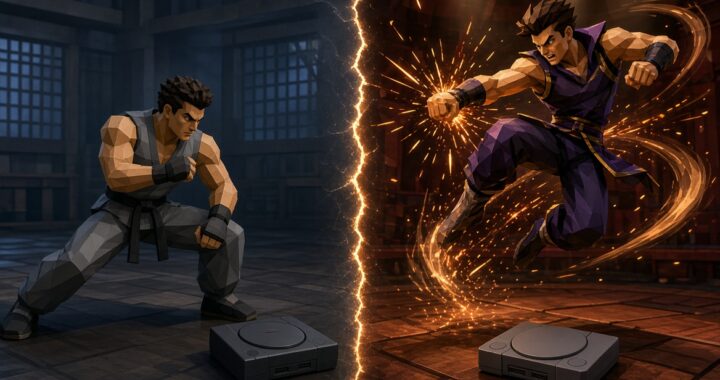
[태그:] Namco Tekken 3 PS1

  • Virtua Fighter vs. Tekken: The 3D Fighting Rivalry That Decided the 32-Bit Console War

    Introduction: The Dawn of the 3D Fighting Era

    In the mid-1990s, the video game industry underwent its most violent paradigm shift. The 2D sprite-based arcade era—once dominated by Capcom’s Street Fighter II and Midway’s Mortal Kombat—was rapidly yielding to the raw potential of real-time 3D polygonal graphics.

    At the epicenter of this revolution stood two arcade juggernauts: Sega’s Virtua Fighter and Namco’s Tekken.

    When home consoles stepped into the 32-bit generation in 1995, these two flagship franchises became the ultimate ideological weapons in the home console war. Sega placed its bets on bringing Yu Suzuki’s pioneering arcade masterpiece to the Sega Saturn, while Sony relied on Namco’s high-octane Tekken port to establish the Sony PlayStation (PS1) as a household name.

    The battle between Virtua Fighter and Tekken was far more than a simple comparison of martial arts mechanics. It was a war over hardware architecture, brand strategy, and the cultural future of interactive media.

    Here is the deep dive into how these two iconic fighters clashed—and why one ultimately secured the throne of the 32-bit era.

    1. The Pioneer: Virtua Fighter and the Sega Saturn Promise

    To understand the 32-bit war, one must first recognize the sheer shock factor of Yu Suzuki’s original arcade release of Virtua Fighter in late 1993. Created by Sega AM2, it was the world’s first fully 3D fighting game.

    +--------------------------------------------------------------------------+
    | VIRTUA FIGHTER (SEGA SATURN, 1995)                                       |
    | Developer: Sega AM2 (Yu Suzuki)                                          |
    | Core Philosophy: Realism, fluid weight dynamics, martial arts accuracy.  |
    | Control Scheme: 3-Button Setup (Punch, Kick, Guard).                    |
    +--------------------------------------------------------------------------+
    

    The Japanese Phenomenon

    In Japan, Virtua Fighter was a cultural religion. Players marvelled at human martial artists rendered in flat-shaded 3D polygons executing authentic Hakkokyoken, Jeet Kune Do, and Pro Wrestling moves.

    When Sega ported Virtua Fighter as a launch title for the Sega Saturn in Japan, it drove unprecedented console sales. In late 1994, Saturn units flew off retail shelves in Tokyo largely due to the desire for an “arcade-at-home” experience.

    The Hardware Reality Check

    However, translating Sega’s expensive Model 1 arcade hardware to the home Saturn system proved challenging:

    • The original Saturn port suffered from noticeable visual compromises, including flickering polygons, clipping errors, and simplified background textures.
    • Sega later redeemed itself with Virtua Fighter Remix and the visually stunning Virtua Fighter 2 (which ran at a silky-smooth 60 frames per second at a high 704×480 resolution), proving the dual-CPU Saturn could handle complex 3D math when pushed to its limits.

    2. The Challenger: Tekken and the PlayStation Powerhouse

    While Sega was perfecting technical martial arts realism, Namco—a long-time arcade rival—was developing its own 3D fighting engine on arcade hardware built directly on Sony’s early PlayStation architecture (the System 11 board).

    +-------------------------------------------------------------------------+
    | TEKKEN (SONY PLAYSTATION, 1995)                                         |
    | Developer: Namco (Seiichi Ishii)                                        |
    | Core Philosophy: Stylized action, juggle combos, cinematic drama.      |
    | Control Scheme: 4-Button Setup (Left Punch, Right Punch, L-Kick, R-Kick).|
    +-------------------------------------------------------------------------+
    

    Why Tekken Captivated Western Audiences

    Released on the PS1 in North America in November 1995, Tekken took a radically different approach to 3D fighting:

    1. Intuitive Limb Control: Namco assigned each of the four face buttons on the PS1 controller directly to an individual limb (Left Punch, Right Punch, Left Kick, Right Kick). This made picking up the controller instantly intuitive for casual players.
    2. Cinematic Flair and Juggles: Rather than strict grounded martial arts, Tekken embraced exaggerated bounce physics, high-damage juggle combos, and flashy particle hit-sparks.
    3. CD-ROM CGI Cutscenes: Capitalizing on the PS1’s CD-ROM storage capacity, Namco included full-motion video (FMV) ending cinematics for every character, turning fighters like Kazuya Mishima, Paul Phoenix, and King into iconic pop-culture figures.

    3. Head-to-Head Comparison: Mechanics, Graphics, and Presentation

    To understand how these titles shaped consumer decisions in 1995–1998, we must compare their foundational mechanics side by side.

    Feature / DimensionVirtua Fighter Series (Saturn)Tekken Series (PlayStation)
    Pacing & GameplayMethodical, grounded, precision timingFast-paced, aggressive, juggle-heavy
    Control Layout3 Buttons (Punch, Kick, Guard)4 Buttons (One button per limb)
    Visual AestheticClean, realistic martial arts animationStylized character models with flashy hit effects
    Home FeaturesPure arcade conversion focusRich unlockable modes, mini-games, FMV endings
    Hardware FitPushed Saturn’s VDP1/VDP2 dual processorsNative match for PS1’s Geometry Engine

    4. The Turning Point: Tekken 3 vs. Virtua Fighter 3

    The decisive moment in the battle for 3D fighting dominance arrived in 1997–1998 during the mid-lifecycle of both systems.

    Virtua Fighter 3 and the Saturn’s Tragic Omission

    Sega AM2 released Virtua Fighter 3 in arcades on their legendary Model 3 hardware, featuring undulating uneven terrain, real-time dodge mechanics, and breathtaking character models.

    However, the hardware requirements were so demanding that the Sega Saturn simply could not handle a port without severe downgrades. A promised Saturn version was delayed repeatedly and ultimately canceled, leaving Saturn owners without the pinnacle chapter of the series.

    Tekken 3: The PlayStation Masterpiece

    Conversely, Namco achieved what many thought impossible on home consoles with Tekken 3 in 1998.

    +-------------------------------------------------------------------------+
    | TEKKEN 3 (PLAYSTATION, 1998)                                            |
    | Widely cited as one of the greatest video games of all time.            |
    | Features: True 3D sidestepping, 60fps animations, Tekken Force Mode,     |
    | Tekken Ball Mode, and over 20 playable characters.                      |
    +-------------------------------------------------------------------------+
    

    By employing clever technical tricks—such as using detailed pre-rendered backgrounds with highly optimized 3D character models—Namco delivered an arcade-accurate experience that sold over 8.3 million copies on the original PlayStation worldwide. It cemented the PS1 as the undisputed home of 3D fighting games.

    Conclusion: Who Won the 32-Bit Fighting War?

    When evaluating the legacy of both franchises, the outcome depends on whether you measure success by pure game design influence or commercial dominance.

    • The Design Champion (Virtua Fighter): Virtua Fighter remains the intellectual founding father of all 3D fighting games. Without Yu Suzuki’s breakthrough, 3D fighting mechanics might have been delayed by years. Its deep, uncompromising physics continue to command respect among hardcore fighting game purists.
    • The Commercial & Cultural Victor (Tekken on PS1): In terms of winning the 32-bit console war, Tekken and the PlayStation claimed a decisive victory. Namco’s accessible limb-based controls, cinematic FMV storytelling, and flawless technical optimization proved that home console ports could transcend their arcade origins and define mainstream youth culture.

    Together, these two extraordinary franchises pushed 32-bit hardware to its absolute limits, transforming polygon technology from an experimental novelty into the dominant artistic medium of modern gaming.

    Frequently Asked Questions (FAQ)

    Q1: Did Sega ever release Virtua Fighter 3 on a home console?

    Yes! While canceled on the Sega Saturn, Sega released Virtua Fighter 3 tb as a flagship launch title for the 128-bit Sega Dreamcast in Japan in 1998 and North America in 1999.

    Q2: Why was Tekken easier to port to the PlayStation than Virtua Fighter was to the Saturn?

    Namco developed the Tekken arcade system (Namco System 11) using architecture closely based on actual PS1 hardware components. This hardware synergy made porting Tekken to the PS1 straightforward, whereas Sega’s Model 1 and Model 2 arcade boards used vastly different architecture than the dual-CPU Saturn.

    Join the Discussion

    Were you team Virtua Fighter on the Sega Saturn or team Tekken on the original PlayStation back in the 1990s? Which character was your ultimate main? Drop your nostalgic memories in the comments below!