[태그:] Super Nintendo

  • SNES 1CHIP Explained: Why Collectors Prefer It and How to Identify One

    Super Famicom / SNES 1CHIP: Why Collectors Hunt It and How to Spot One

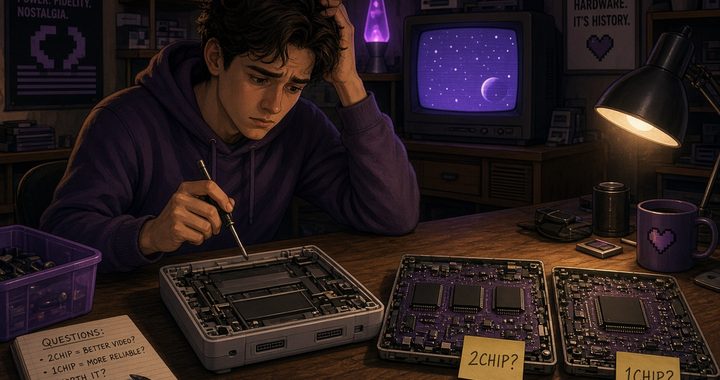
    The Super Nintendo Entertainment System (SNES) and its Japanese counterpart, the Super Famicom, went through multiple motherboard revisions during their long production run. The most talked-about change arrived around 1995 when Nintendo combined the main CPU and the two Picture Processing Units (PPU1 and PPU2) into a single custom chip. These later boards are known as 1CHIP models (labeled SNS-CPU-1CHIP-01, -02, or -03).

    For many retro enthusiasts who care about video quality—especially when using RGB SCART cables, upscalers like the OSSC or RetroTINK, or high-end CRTs—the 1CHIP is the preferred original hardware.

    Main Advantages of the 1CHIP

    The biggest benefit is video quality.

    Earlier “2-chip” (or 3-chip) boards produced a noticeable horizontal blur or soft smear on RGB output. The separate video chips and the way the signal was processed created a low-pass filtering effect. The 1CHIP design eliminates most of that interference. The result is:

    • Sharper, cleaner pixel edges
    • Better contrast and more defined colors
    • Reduced horizontal smearing
    • A picture that looks closer to what modern emulation or FPGA cores deliver

    This difference is most obvious on RGB connections. On composite or RF the gap is smaller, but RGB is where the 1CHIP truly shines. Many collectors and content creators specifically seek 1CHIP units for cleaner capture and more accurate-looking gameplay on modern displays or high-quality CRTs.

    Other practical upsides include slightly lower power draw and a more modern single-chip architecture that generally ages well when capacitors are replaced.

    Important Caveats

    The 1CHIP is not perfect:

    • The stock RGB signal is often too bright, which can cause mild washing-out or ringing. A simple three-resistor mod (750 ohm) usually corrects this.
    • Some units show slight ghosting.
    • A small number of games have minor graphical quirks (rare top-line garbage or timing differences).
    • The final revision (1CHIP-03) does not output composite sync on the multi-out port by default, so you may need a sync-on-luma cable or a small restore mod.

    Despite these points, most people who prioritize sharp RGB still prefer a properly adjusted 1CHIP over earlier boards.

    How to Identify a 1CHIP Console

    1. Open the console (most reliable method) Use a 4.5 mm Gamebit screwdriver to remove the top shell. Look at the motherboard near the cartridge slot. You should see silkscreen text that clearly reads:

    • SNS-CPU-1CHIP-01
    • SNS-CPU-1CHIP-02
    • SNS-CPU-1CHIP-03

    (There are equivalent labels on Super Famicom and PAL boards.) You will also notice one large square chip (the S-CPUN) instead of the separate CPU + two PPU chips found on earlier boards.

    2. Serial number clues (North American SNES) Many 1CHIP units carry serial numbers starting with UN3. This is a strong indicator but not 100% proof—case swaps exist. Treat “UN3” as a useful filter when shopping online, then verify by opening the unit if possible.

    3. Expansion port check (quick external hint on some models) On the bottom of the console there is a small expansion door. On certain boards you can peek inside:

    • Three solder dots usually mean a 2-chip board.
    • A partial circular ring or different layout often indicates 1CHIP.

    This method is helpful but less definitive than reading the silkscreen.

    4. Super Famicom (Japanese) note Japanese Super Famicom units do not have a reliable external serial-number shortcut like the North American UN3 prefix. Opening the console is essentially required for confirmation.

    Quick Comparison

    FeatureEarly 2-Chip Boards1CHIP Boards
    Video ChipsSeparate CPU + PPU1 + PPU2Single integrated S-CPUN chip
    RGB SharpnessSoft / blurredNoticeably sharper
    Color & ContrastMore muted / smearedCleaner and more vibrant
    Brightness (stock)Generally balancedOften too bright (easy fix)
    Rarity & PriceCommon, cheaperLess common, higher demand
    Best ForMaximum compatibilityBest possible RGB picture

    Buying Tips for Collectors

    • Ask sellers for clear photos of the motherboard silkscreen. “1CHIP” claims without board photos should be treated cautiously.
    • If you plan to use RGB, a 1CHIP-01 or 1CHIP-02 is usually the easiest starting point. The -03 revision needs a bit more attention regarding sync.
    • Budget for a capacitor replacement and the brightness resistor mod if you want the best results.
    • The later SNES Jr. (SNS-101) also uses the same 1CHIP architecture and can look excellent once RGB is restored, though it lacks some original ports.

    The 1CHIP did not change how the Super Nintendo plays games in any dramatic way, but it did give the system a cleaner, sharper video output that many modern collectors value highly. Whether you are building a high-end RGB setup or simply want the best original-hardware picture possible, knowing how to identify and evaluate these late-production boards is one of the most useful skills in SNES collecting.

    If you already own a console and are unsure which revision you have, the safest answer is always the same: open it up and read the board.

  • The $6,000 Heartbreak: Why I’m Still Mourning My Lost 90s Game Magazines

    Hi everyone, it’s Super Asurada 77.

    Today, I found myself wandering down memory lane, and I stumbled upon a memory so bittersweet it almost made me faint. It’s one of those “laugh so I don’t cry” stories.

    Do you remember your “Number One Treasure” from childhood? For me, it wasn’t a toy or a bike—it was my collection of video game magazines.

    The Beginning of a Lifelong Obsession: My Middle School Years

    The year was 1990. I was just a middle school kid when a single book at the local bookstore changed my life forever.

    It was the very first issue of ‘Game World’ (게임월드).

    Back then, I was obsessed with consoles like the Famicom and Super Famicom. Seeing those vibrant game illustrations and incredibly detailed walkthroughs was like discovering a new world. I still remember the thrill of holding that first issue in my hands, bought with the 5,000 KRW allowance my grandfather gave me.

    From that day on, my month revolved around waiting for the next issue of Monthly Game World.

    A World Beyond the Screen: Game World and Game Champ

    From middle school onwards, I was a loyal subscriber. If Game World or Game Champ was on the shelf, it was coming home with me.

    I didn’t always have the money to buy the actual consoles or the latest cartridges, so those magazines were my window into that universe. I would pore over the photos and read the descriptions until I knew them by heart. Game Champ came along a bit after Game World, and I collected those too.

    I even meticulously saved all the special bonuses—the BGM cassette tapes and CDs that came as supplements. They were the crown jewels of my collection.

    The Great Catastrophe: My Time in the Military

    But as they say, all good things must come to an end. In January 1998, I received my “call to duty” and enlisted in the military.

    After the grueling weeks of basic training and being assigned to my unit, I finally got my first sweet taste of leave. I headed back home—or rather, to the new house my family had moved into while I was away. I opened the door to my new room, and my heart sank.

    “Wait… where are all my magazines?”

    I searched every corner, but my precious collection was nowhere to be found.

    “Dad,” I asked, “Have you seen the books that were in my room?”

    The Fatal Words: “Oh, those? I threw them away!”

    My father’s reply was casual, almost breezy: “Oh, those? We were moving, and they were just taking up space and too heavy to carry. So I tossed them out!”

    Yes… you read that right. Years of passion, loyalty, and “geek” history had been swept away by the tide of a house move and ended up in a landfill.

    The shock I felt in that moment… even thinking about it now brings a tear to my eye.

    Years Later, a Shocking Discovery

    Fast forward to the late 2000s. I was browsing the internet and happened to click on a vintage collector’s site.

    Out of curiosity, I searched for ‘Game World Issue #1.’

    I nearly fell out of my chair when I saw the price.

    A single copy of Game World Issue #1 was being traded for anywhere between $400 and $750 (500k to 1M KRW).

    Wait… how much? $750?!

    What used to be a $4 magazine bought with pocket money had become a legendary “holy grail” of retro items. Other issues were easily going for over $100 each.

    If I still had that entire collection I had built up… how much would it be worth today? Probably around $6,000 (8 Million KRW)? (Haha… sob).

    Where are you now, my dear magazines?

    It’s painful to realize that the “stacks of paper” my father tossed out were actually “golden geese” that would be worth a fortune today.

    But beyond the money, it’s the loss of that pure passion and the memories of my youth that hurts the most. I deeply miss those days of Game World and Game Champ.

    Hey, publishers! If the Neo Geo AES can get a “mini” reissue, can’t we get a reprint of these legendary magazines too? A guy can dream, right?

    Just as a heads-up, you can find Game Champ archived as e-books on the GameMeca website [link]

    Original article in Korean: [link]