[태그:] retro gaming

  • Emulator vs FPGA: What’s the Real Difference and Does FPGA Actually Have Zero Latency?

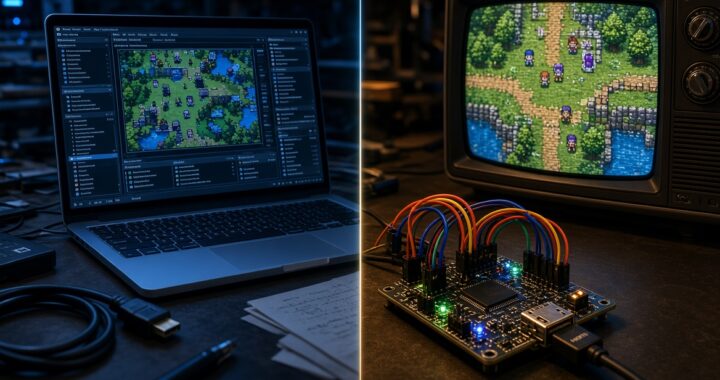
    Retro gaming has exploded in popularity over the past decade. Collectors and casual players alike are no longer satisfied with just playing the games—they want the closest possible experience to the original hardware. This has created two dominant approaches: software emulators and FPGA-based recreations.
    If you’ve spent any time in the retro community, you’ve probably heard people claim that FPGA systems have “zero latency” while emulators are laggy by nature. But is that actually true? Let’s break down the real differences between emulators and FPGA, and take a closer look at the latency question.

    What Is a Software Emulator?

    A software emulator is a program that runs on a modern computer, phone, or handheld and simulates the behavior of an old game console’s hardware. Popular examples include RetroArch, DuckStation, PCSX2, Dolphin, and Mesen.

    Emulators work by interpreting or translating the original console’s instructions into something a modern CPU can understand. The better the emulator, the more accurately it recreates the original system’s timing, graphics quirks, and sound behavior.

    Pros of emulators:

    • Extremely convenient and inexpensive (or free)
    • Easy access to save states, rewind, upscaling, and shaders
    • Can run on almost any modern device
    • Constantly improving accuracy through community development

    Cons of emulators:

    • Input lag can vary depending on the host system, display, and settings
    • High-accuracy (especially cycle-accurate) emulation is very demanding on hardware
    • Some systems are still not perfectly emulated

    What Is FPGA Recreation?

    FPGA stands for Field-Programmable Gate Array. Instead of simulating the original hardware with software, an FPGA is a reconfigurable chip that can be programmed to behave like the original console’s custom chips at a hardware level.

    Projects like the MiSTer FPGA, Analogue Pocket, Analogue Nt Mini, and Analogue Super Nt use this approach. Rather than “pretending” to be a console, the FPGA is wired to function as a near-clone of the original silicon.

    Pros of FPGA:

    • Extremely high hardware accuracy
    • Consistent, predictable performance
    • Very low input lag when properly configured
    • No reliance on a powerful host CPU

    Cons of FPGA:

    • More expensive than running emulators
    • Limited to the cores that have been developed
    • Less convenience features (save states, rewind, etc. are often limited or absent)
    • Requires more technical knowledge to set up (especially MiSTer)

    Key Differences at a Glance

    AspectSoftware EmulatorFPGA Recreation
    MethodSoftware simulationHardware reimplementation
    AccuracyVaries (good to excellent)Extremely high
    LatencyCan be low with tuningConsistently very low
    ConvenienceExcellentModerate
    CostLow / FreeHigh
    Hardware DemandHigh for accuracyLow once configured
    Future-proofingDepends on software supportDepends on core development

    Does FPGA Really Have Zero Latency?

    This is the claim that gets repeated the most—and it’s also the most misunderstood.

    The short answer is: No, FPGA does not have true zero latency. But it comes much closer to the original hardware experience than most people realize.

    Here’s why the “zero latency” claim exists:

    1. No software buffering layers Emulators run on top of an operating system. Even well-optimized ones have to deal with the host OS’s input polling, frame buffering, and display pipeline. FPGA cores talk more directly to the video output and controllers.
    2. Cycle-accurate timing High-quality FPGA cores recreate the original console’s timing down to the clock cycle. This means the relationship between controller input and on-screen response is extremely close to the original hardware.
    3. Lower display lag in practice When paired with a low-lag display (or a CRT), FPGA systems often measure under 1–2 frames of total lag from button press to pixel response. Many software emulators, even with run-ahead and frame delay enabled, struggle to match this consistency across different systems.

    However, “zero latency” is marketing language. Every digital system has some delay:

    • Controller polling still takes time
    • HDMI signal processing adds a small amount of lag
    • Modern LCD/OLED panels have their own response times
    • Even original hardware on a CRT was never truly “zero lag”

    What FPGA actually delivers is latency that is consistently very close to original hardware, and often lower than the average software emulator setup in the real world.

    It’s also worth noting that modern emulators have closed the gap significantly. Features like run-ahead, frame delay, and rollback netplay mean that a well-tuned emulator on a powerful PC can feel extremely responsive—sometimes even better than original hardware in certain cases. The difference is that FPGA achieves this consistency with far less tuning and system load.

    Which One Should You Choose?

    There’s no universal winner. It depends on what you value most.

    Choose FPGA if:

    • You want the closest possible experience to original hardware
    • Low and consistent latency is a top priority
    • You’re willing to invest more money and time into setup
    • You mainly play systems that have mature FPGA cores (NES, SNES, Genesis, Neo Geo, etc.)

    Choose emulators if:

    • You want convenience, portability, and features
    • You play a wide variety of systems (including more modern ones)
    • Budget is a concern
    • You enjoy tweaking settings and shaders

    Many serious retro enthusiasts end up using both. FPGA for the systems they care about most, and emulators for everything else.

    Final Thoughts

    The emulator vs FPGA debate often gets oversimplified into “FPGA is perfect, emulators are laggy.” Reality is more nuanced. FPGA offers outstanding accuracy and very low, consistent latency that closely matches original hardware. Emulators continue to improve rapidly and remain the most accessible way to play classic games.

    If your goal is the purest possible experience with minimal lag, a well-set-up FPGA system is currently the closest thing we have to owning the original console—without the reliability issues of 30- to 40-year-old hardware. But for most players, a carefully configured emulator will still deliver an excellent experience.

    The best approach is simply to try both and decide based on how it feels to you.

  • The Legendary Neo Geo AES: Launch Price, Pack-In Games, and Early vs. Later Model Differences

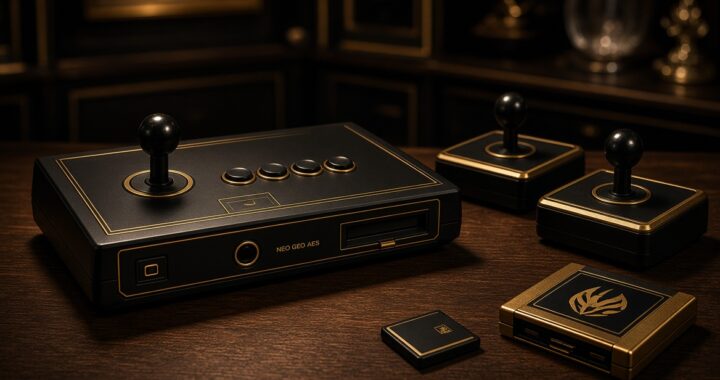
    When SNK launched the Neo Geo AES (Advanced Entertainment System) in the early 1990s, it wasn’t just another home console. It was an arcade machine for your living room — the same hardware that powered SNK’s Multi Video System (MVS) cabinets. For American gamers who could afford it, the Neo Geo delivered true arcade-perfect gameplay at a time when most home systems were still making compromises.
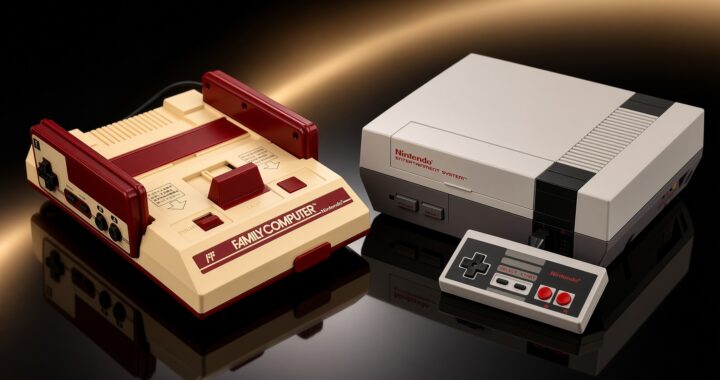
    Launch Price: The Most Expensive Console of Its Era

    In North America, the Neo Geo AES officially went on sale on July 1, 1991. SNK positioned it as a premium product from day one.

    The flagship package was known as the Gold System, which retailed for $649.99. That price included:

    • The console itself
    • Two large arcade-style joystick controllers
    • A memory card
    • One pack-in game

    A more affordable Silver System was also offered at $399.99. It came with only one controller and no pack-in game.

    Individual game cartridges launched at around $200 and quickly climbed higher — some titles eventually sold for $300–$600 new. Adjusted for inflation, the Gold System’s $650 price tag equals well over $1,500 in today’s money. This made the Neo Geo the most expensive home console ever released at the time and limited its audience to serious enthusiasts and collectors.

    Games Released Alongside the Console

    The Neo Geo’s early software library was small but high-quality. Several titles that had already proven themselves in arcades (or were developed simultaneously for both MVS and AES) arrived near the console’s retail launch.

    Key early titles associated with the system’s debut period include:

    • Magician Lord — Frequently cited as the most common pack-in game for the Gold System in the U.S. (early boxes even carried a gold sticker highlighting its inclusion). A colorful side-scrolling action-platformer that showcased the system’s graphics and sound.
    • NAM-1975 — A run-and-gun shooter set during the Vietnam War era.
    • Baseball Stars Professional — A sports title that was originally planned as a possible pack-in option.
    • Top Player’s Golf
    • Riding Hero
    • Cyber-Lip
    • The Super Spy
    • Ninja Combat

    These games demonstrated what the Neo Geo could do that other 16-bit systems of the era could not: large, colorful sprites, smooth animation, and arcade-accurate sound. Because the AES used the exact same hardware as the MVS arcade boards, there was no “porting” quality loss — what you played at home was identical to the coin-op version.

    Early vs. Later Neo Geo AES Models: What’s the Difference?

    Although the Neo Geo AES hardware remained functionally the same throughout its life (1990–1997), SNK made several revisions over the years. Collectors and enthusiasts often distinguish between early and later models based on these changes.

    1. Power Supply and Power Consumption

    • Early models used a DC 5V power adapter and consumed around 8 watts.
    • Later revisions switched to a DC 9V adapter and dropped power consumption to approximately 5 watts. This is one of the most reliable ways to identify the era of a console.

    2. Motherboard Revisions SNK produced multiple motherboard revisions (commonly referred to by collectors as AES3-1 through AES3-6 and similar designations).

    • Very early boards sometimes included additional daughterboards to improve video output clarity.
    • Mid-period revisions (particularly 3-3 and 3-4) had cost-cutting changes that removed certain capacitors from the audio circuit. This resulted in slightly degraded or unbalanced sound on some units. Later revisions (3-5 and beyond) restored the missing components.
    • Overall video quality and RGB output can vary slightly between revisions, which is why many collectors prefer later boards or perform simple capacitor fixes on earlier ones.

    3. Cartridge Capacity Support The original system specification advertised “Max 330 Mega.” As games grew larger later in the system’s life, SNK introduced bank-switching techniques that allowed cartridges up to 716 megabits. Later consoles handled these larger “Giga Power” cartridges without issue, while the hardware itself remained compatible with all earlier titles.

    4. Cosmetic and Packaging Differences Early U.S. units were often sold in the Gold System packaging with the distinctive gold sticker. Later production runs and regional variations showed minor changes in labeling, box art, and included accessories. A limited gold-colored console was also produced in small numbers (primarily for the Japanese market).

    In practical terms, every official Neo Geo AES can play the entire library. The differences are mostly about build quality, power efficiency, audio fidelity on certain revisions, and long-term reliability. Many modern collectors prefer later revisions for their refined audio circuits and lower power draw.

    Why the Neo Geo Still Matters

    The Neo Geo AES never competed on volume with the Super Nintendo or Sega Genesis. Its high price kept it in a niche. Yet that same exclusivity helped create one of the most respected and collectible libraries in retro gaming. Titles such as Fatal Fury, Art of Fighting, Samurai Shodown, and later Metal Slug and The King of Fighters series turned the system into a legend.

    For American retro gaming fans today, original AES hardware remains the purest way to experience these games without emulation. Understanding the launch price, the early software lineup, and the subtle differences between early and later models helps collectors make informed decisions and appreciate just how ambitious SNK’s vision was in 1991.

    Whether you’re hunting for a clean later-revision console or simply want to know why a 30-year-old system still commands respect, the Neo Geo AES stands as a high-water mark of arcade-to-home translation.

  • The Day the World Changed: Remembering the Mind-Blowing Debut of the Original Game Boy

    T

    There is a distinct nostalgia that only kids of the late ’80s and early ’90s will truly understand. It was the era of CRT televisions, wired controllers, and being tethered to a living room carpet if you wanted to play video games.

    Then, in 1989, Nintendo dropped a chunky, grey brick into our hands—and suddenly, the universe expanded.

    The original Nintendo Game Boy (DMG-01) wasn’t just a new gadget; it was a cultural shift. Looking back today, it’s hard to fathom how a tiny olive-green monochrome screen could captivate an entire generation. But at the time, it felt like absolute magic.

    The Unforgettable Ritual: 4 AA Batteries and Pure Freedom

    Before the Game Boy, gaming was strictly an indoor activity. You had to ask permission to use the family TV, hook up the NES, and stay within six feet of the console.

    The Game Boy shattered those boundaries. The magic started with a simple, incredibly satisfying ritual:

    1. Sliding open the heavy battery door on the back.
    2. Snapping in four AA batteries (and praying they were fresh Duracells).
    3. Sliding the heavy power switch on top, hearing that legendary “Ba-ding!” as the Nintendo logo descended down the screen.

    Suddenly, you weren’t trapped in your living room anymore. You were playing Super Mario Land on the school bus, in the backseat of a family station wagon during endless road trips, or sitting outside on the front porch under the summer sun.

    Super Mario and Tetris in the Palm of Your Hand

    The pack-in game, Tetris, along with Super Mario Land, redefined what a portable experience could be.

    Hearing that iconic Soviet-inspired Tetris chiptune blasting from the tiny, tinny mono speaker felt surreal. You weren’t playing a dumbed-down LCD game like the Game & Watch; you were playing a full-fledged video game with tight controls, endless replayability, and soundtrack tunes that stay stuck in our heads three decades later.

    Super Mario Land proved that an entire platforming kingdom could fit inside your pocket. Guiding Mario past crumbling blocks and flying enemies while sitting in a dentist’s waiting room felt like living in the future.

    How Did We Play for Hours on That Blurry Screen?

    If you hand an original Game Boy to a kid today, their first reaction is usually confusion:

    “Where is the backlight? Why is everything green? How can you even see this?”

    Let’s be honest: by modern standards, that original STN LCD screen was brutal. There was no built-in backlight. If you moved the console too fast, the pixels left a blurry ghost trail across the screen.

    So how on earth did we spend 4 to 5 hours straight staring at that tiny, contrast-deprived display without our eyes falling out?

    1. The Art of “Light Hunting”

    We became experts in physics and light angles without realizing it. We constantly tilted the Game Boy toward streetlamps, bedroom nightlights, or sunlight streaming through the car window. Remember those ridiculous clip-on magnifying glasses with built-in lights (like the Worm Light or Light Boy)? They were clunky, but they were our lifesavers.

    2. Pure, Unadulterated Imagination

    Back then, graphics weren’t expected to look like real life. Our brains easily filled in the gaps. A few dark green pixels were a fully realized Goomba; a crude square was a falling Tetromino block. The immersion came from the gameplay loop, not the resolution.

    3. The Novelty of Portability Overrode Everything

    The sheer shock of having interactive entertainment on the go was so powerful that eye strain simply didn’t matter. The temporary headache was a small price to pay for gaming absolute freedom.

    A Timeless Icon of Gaming History

    Today’s portable consoles—like the Nintendo Switch or Steam Deck—boast OLED screens, 4K dockability, and graphics that rival cinema. Yet, none of them will ever match the sheer seismic impact of the original Game Boy.

    It transformed video games from a home pastime into a lifestyle. It proved that great games don’t need millions of colors or backlit displays—they just need great design, a couple of buttons, and four reliable AA batteries.

    To anyone who survived the non-backlit screen era: we were true pioneers.

  • Famicom vs. NES: A Technical and Collector’s Comparison of 8-Bit Classics

    Introduction: The Genesis of Modern Home Gaming

    When retro gaming enthusiasts in North America reflect on the 8-bit era, the image that usually comes to mind is the iconic grey, boxy Nintendo Entertainment System (NES). Released in North America in 1985, the NES single-handedly revitalized a home video game market that had collapsed under the weight of low-quality titles and saturated hardware.
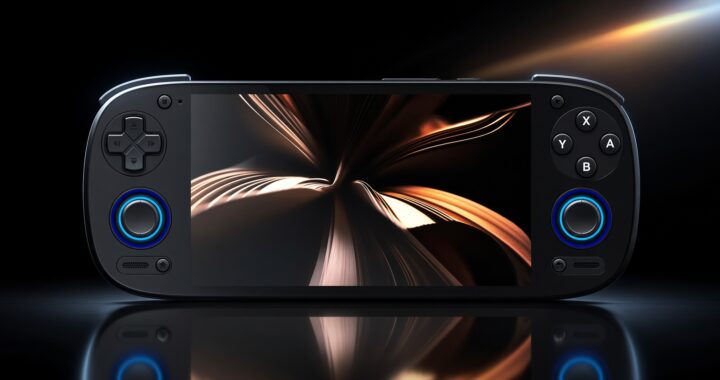
    However, two years before the Western world received its “toaster-style” console, Nintendo launched a red-and-cream revolution in Japan. Released on July 15, 1983, the Family Computer—universally abbreviated as the Famicom—was the true foundation of Nintendo’s home console empire.

    For modern retro gaming collectors, preserving and exploring the original Famicom provides fascinating insights into hardware design, region-specific software releases, and audio engineering. This comprehensive guide explores the rich history, technical nuances, sound enhancements, and unique library of the original Japanese Famicom.

    1. Aesthetic and Industrial Design: Famicom vs. Western NES

    To understand why the Famicom occupies such a special place in video game history, one must first look at the stark design differences between the Japanese original and its Western counterpart.

    The Japanese Vision (1983)

    Designed by Masayuki Uemura, the original Famicom was deliberately fashioned to look friendly, approachable, and affordable.

    • Color Palette: Featuring a distinctive deep crimson (maroon) and off-white plastic shell, the console resembled an inviting toy rather than an intimidating piece of high-end home electronics.
    • Form Factor: Compact and lightweight, the Famicom featured a top-loading cartridge slot, a mechanical eject lever, and built-in side holsters to store the two included controllers.

    The Western Adaption (1985)

    Following the North American video game crash of 1983, Western retailers were deeply skeptical of any product labeled as a “video game console.” To bypass this retailer hesitation, Nintendo of America completely redesigned the housing:

    • Front-Loading VCR Mechanism: The NES was styled to look like a contemporary VCR (Videocassette Recorder), hiding the cartridge slot behind a hinged door.
    • Neutral Tone: The bright crimson was replaced with dark and light grey tones, creating a neutral aesthetic intended to blend seamlessly into living room entertainment centers.

    While both machines shared core 8-bit internal architecture (specifically the Ricoh 2A03 8-bit processor running at approximately 1.79 MHz in NTSC regions), their external designs could not have been more distinct.

    2. Hardware Quirks and Unique Features

    Collecting and playing on original Famicom hardware introduces several unique physical and electrical quirks that set it apart from standard NES consoles.

    Hardwired Controllers and the Player 2 Microphone

    One of the most surprising features of the original Famicom is its fixed controller setup. Unlike the NES, which featured front-facing detachable controller ports, the original Famicom had its two controllers permanently hardwired into the rear of the motherboard.

    Even more intriguing is the controller functionality:

    1. Player 1 Controller: Features standard Directional Pad, A, B, Start, and Select buttons.
    2. Player 2 Controller: Omits the Start and Select buttons entirely. In their place, Nintendo included a small microphone and a volume slider switch.

    While relatively few games utilized this microphone, a notable example is the original Japanese release of The Legend of Zelda (Hyrule Fantasy: Zelda no Densetsu). In the Japanese version, players could defeat the large-eared enemy known as “Pols Voice” by making noise into the Player 2 microphone—a mechanic completely altered for the Western NES release.

    Cartridge Form Factor: 60 Pins vs. 72 Pins

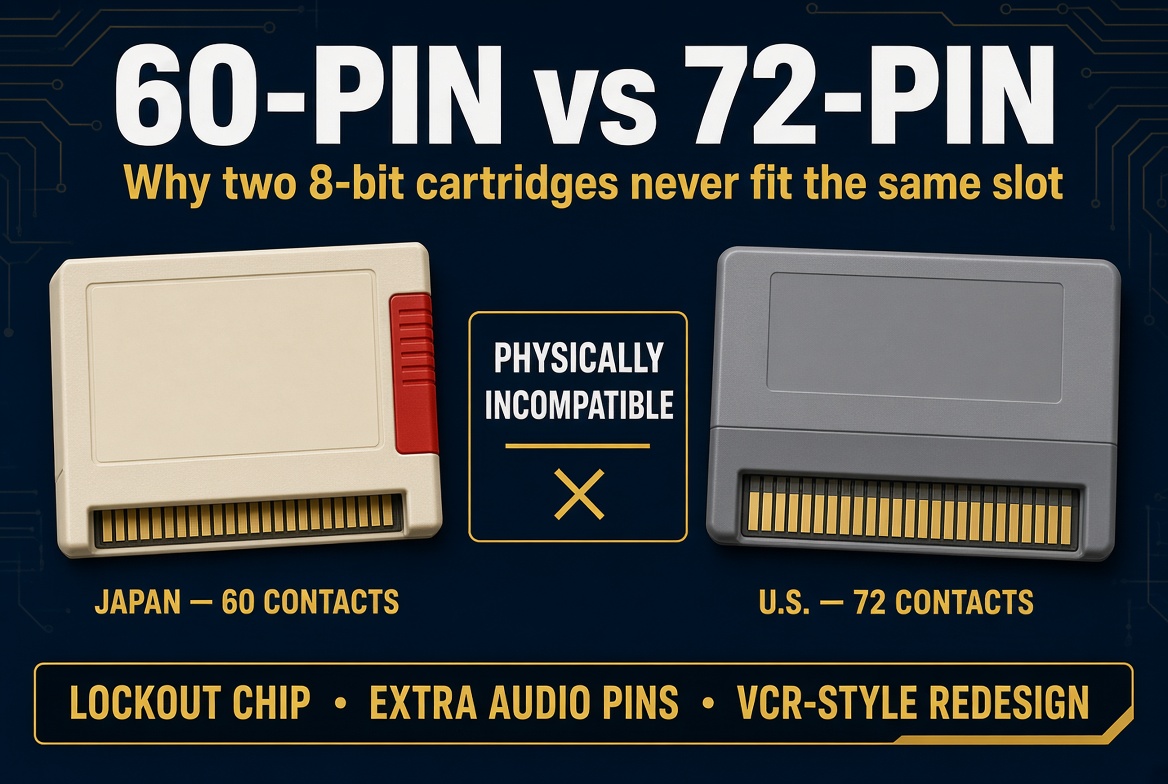
    The Famicom utilizes a compact 60-pin cartridge format, whereas Western NES cartridges feature a much larger 72-pin format. The extra pins on the NES cartridge connector were primarily added to accommodate the 10NES Lockout Chip (an anti-piracy regional lock mechanism) and expanded audio routing lines.

    3. The Chiptune Masterpiece: Expanded Audio Capabilities

    For sound engineers, music historians, and chiptune enthusiasts, the Famicom possesses a legendary advantage over the stock Western NES: native cartridge audio expansion support.

    How Expanded Audio Works

    The original Famicom cartridge slot was wired to allow game cartridges to route extra audio channels directly into the console’s mixing circuit. Developers could embed custom audio processing chips inside individual game cartridges, supplementing the built-in sound capabilities of the Ricoh processor.

    The standard Ricoh 2A03 chip provided five basic sound channels:

    • 2 Pulse wave channels
    • 1 Triangle wave channel
    • 1 Noise channel
    • 1 PCM Delta Modulation Channel (DMC)

    With audio expansion chips, developers could add complex FM synthesis, extra pulse channels, and custom wavetable audio.

    Landmark Expanded Audio Chips

    • Konami VRC6: Featured in Akumajou Densetsu (Castlevania III: Dracula’s Curse in Japan). It added two extra pulse waves and a sawtooth wave, producing an extraordinarily rich, multi-layered orchestral soundtrack. The Western NES version lacked this chip due to pinout differences, resulting in a significantly simplified audio arrangement.
    • Sunsoft 5B: Used in titles like Gimmick!, this chip delivered deep basslines and rich synthesis that remains a highlight of 8-bit music production.
    • Namco 163: Supported up to eight additional custom wavetable sound channels, featured in games like Rolling Thunder and Final Lap.

    4. The Famicom Disk System (FDS)

    In 1986, Nintendo introduced a major peripheral expansion in Japan: the Famicom Disk System (FDS).

    Solving the Storage and Cost Challenge

    In the mid-1980s, high-capacity ROM chips were extremely expensive to manufacture. The FDS bypassed this limitation by utilizing double-sided proprietary 3-inch floppy disks, known as “Disk Cards.”

    • Rewritable Kiosks: Japanese gamers could take their Disk Cards to retail kiosks called “Disk Writers” and rewrite new games onto them for a fraction of the cost of buying a new cartridge.
    • Save State Support: The magnetic media allowed players to save their progress directly to the disk, eliminating the need for complex, error-prone password systems.

    Historic franchises such as The Legend of Zelda, Metroid, Kid Icarus, and Castlevania actually made their debut on the Famicom Disk System before being converted into standard cartridge formats for Western NES release. Furthermore, the FDS unit contained its own wavetable audio synthesis channel, giving FDS titles a distinct acoustic warmth.

    5. Navigating the Famicom Library: Exclusives and Hidden Gems

    Because the Famicom had an exceptionally long lifecycle in Japan (with official production running until 2003!), its software library is vast, spanning thousands of official releases, unlicensed software, and region-locked gems.

    Notable Famicom Exclusives

    1. Joy Mech Fight (1993): A late-era 2D fighting game developed by Nintendo. It utilized creative sprite manipulation techniques to deliver smooth fighting animations on 8-bit hardware.
    2. Splatterhouse: Wanpaku Graffiti (1989): A delightful, super-deformed (chibi) side-scrolling action-platformer spinoff of Namco’s famous horror arcade series.
    3. Sweet Home (1989): Developed by Capcom and directed by Kazuo Tokuro, this survival-horror RPG served as the direct spiritual predecessor to the Resident Evil franchise.
    4. Crisis Force (1991): A breathtaking vertical-scrolling shooter by Konami that pushed the Famicom hardware to its absolute limit with fast-paced action and zero sprite flicker.

    Economic Value for Collectors

    For retro game collectors on a budget, collecting Japanese Famicom games is often far more economical than collecting North American NES titles. Iconic titles like Super Mario Bros., Rockman (Mega Man), and Dracula Densetsu (Castlevania) are frequently available at a fraction of the price of their North American cartridge counterparts.

    How to Integrate the Famicom into a Modern Setup

    If you are looking to add Japanese 8-bit gaming to your personal setup, there are several practical ways to approach hardware compatibility:

    MethodVideo Output QualityCompatibilityRecommended For
    Original HVC-001 FamicomRF (Coaxial) Only100% Native 60-PinPurists willing to perform AV/RGB mods
    AV Famicom (HVC-101)Composite AV (RCA)100% Native + Detachable ControllersBest original hardware experience
    NES + Cartridge AdapterComposite / RGB (Depends on NES)High (60-to-72 pin passive adapter)Gamers who already own an NES
    FPGA / Clone SystemsHDMI (1080p Crystal Clear)Excellent (Native Cartridge Slots)Modern TV displays and casual play

    Note: If you purchase an original Japanese console, ensure you use a power supply compatible with your local region’s electrical grid standards to prevent damage to the internal voltage regulator.

    Conclusion

    The Japanese Famicom is far more than a nostalgic relic; it is a foundational milestone in interactive media history. From its vibrant crimson design and innovative microphone integration to its sophisticated audio expansion capabilities, the console represents Nintendo at its most creative and ambitious.

    Whether you choose to explore its library through original hardware, specialized FPGA consoles, or cartridge converters, delving into the Famicom universe offers a fascinating fresh perspective on the 8-bit era.

    Community Discussion

    Do you collect Japanese Famicom cartridges, or do you stick strictly to regional NES releases? What are your favorite expanded-audio chiptune soundtracks? Share your thoughts, questions, and favorite hidden gems in the comments section below!

  • 📼 From Blockbuster Nights to Family Couch Commutes: The Evolution of My Weekend

    Hey everyone, it’s SuperAsrada77.

    These days, the standard Monday-to-Friday, 9-to-5 is just a given, but some of us still remember the era before streaming took over our lives. The feeling of finally clocking out on a Friday evening—or leaving a long Saturday morning shift—had a very specific, almost magical sense of liberation that just hits differently than it does today.

    Back in those days, my perfect “kick-off the weekend” routine was set in stone.

    My Ultimate Throwback Weekend Starter Pack:

    • Step 1: The Blockbuster Pilgrimage Heading straight to the local video rental store and praying the copy of that brand-new DVD release behind the “New Release” shelf wasn’t already taken.
    • Step 2: The Entertainment Top-Up Renting a new video game for the weekend, or swinging by the local comic book shop to grab the latest issues.
    • Step 3: The Convenience Store Run Grabbing a cold six-pack of beer and a family-sized bag of Doritos (or calling in a local pizza on the way home).

    My hands were heavy carrying all those plastic bags and rental cases, but my footsteps had never felt lighter.

    Cracking open a cold beer, tearing open a bag of chips, and popping that DVD into the player—that solitary, uninterrupted time was my own slice of heaven. It was a simple, guaranteed happiness that made me feel like I owned the world.

    👨‍👩‍👧 From Solo Chilling to Shared Weekends

    Don’t get me wrong; I deeply loved the freedom of my bachelor days. But fast forward to today, and the landscape of my weekends has completely transformed.

    The dining table where I used to drink my beer alone is now crowded with my family. Instead of staring at a small monitor by myself, we are all huddled together on the living room couch, laughing and talking over whatever is playing on the TV. The peaceful solitude of my past was great, but having a family by my side to share every minute of the weekend makes my life feel infinitely more complete and fulfilling.

    📻 Missing the Analog Vibe in a Digital World

    Sometimes, when I’m walking through the neighborhood, I’ll pass by an old storefront that used to be a Blockbuster or Hollywood Video, now turned into a pharmacy or a dental clinic.

    We live in a world of absolute convenience now. With Netflix and a smartphone, you can access endless content with just a few taps. But honestly? I miss the distinct smell of popcorn and plastic cases. I miss the tactile, retro charm of pacing up and down the aisles, physically picking up boxes, and agonizing over what to rent for the night.

    The rental stores may be gone, but the excitement I felt for the weekend back then has been entirely replaced by a new kind of excitement—one that I get to build with my wife and kids.

    What about you? What gets you excited as the weekend approaches? Whether it’s a fond memory from the past or the everyday happiness of the present, I hope your weekend is filled with warmth and joy.

    Have a great weekend, everyone!

    Original article in Korean: [link]

  • The $6,000 Heartbreak: Why I’m Still Mourning My Lost 90s Game Magazines

    Hi everyone, it’s Super Asurada 77.

    Today, I found myself wandering down memory lane, and I stumbled upon a memory so bittersweet it almost made me faint. It’s one of those “laugh so I don’t cry” stories.

    Do you remember your “Number One Treasure” from childhood? For me, it wasn’t a toy or a bike—it was my collection of video game magazines.

    The Beginning of a Lifelong Obsession: My Middle School Years

    The year was 1990. I was just a middle school kid when a single book at the local bookstore changed my life forever.

    It was the very first issue of ‘Game World’ (게임월드).

    Back then, I was obsessed with consoles like the Famicom and Super Famicom. Seeing those vibrant game illustrations and incredibly detailed walkthroughs was like discovering a new world. I still remember the thrill of holding that first issue in my hands, bought with the 5,000 KRW allowance my grandfather gave me.

    From that day on, my month revolved around waiting for the next issue of Monthly Game World.

    A World Beyond the Screen: Game World and Game Champ

    From middle school onwards, I was a loyal subscriber. If Game World or Game Champ was on the shelf, it was coming home with me.

    I didn’t always have the money to buy the actual consoles or the latest cartridges, so those magazines were my window into that universe. I would pore over the photos and read the descriptions until I knew them by heart. Game Champ came along a bit after Game World, and I collected those too.

    I even meticulously saved all the special bonuses—the BGM cassette tapes and CDs that came as supplements. They were the crown jewels of my collection.

    The Great Catastrophe: My Time in the Military

    But as they say, all good things must come to an end. In January 1998, I received my “call to duty” and enlisted in the military.

    After the grueling weeks of basic training and being assigned to my unit, I finally got my first sweet taste of leave. I headed back home—or rather, to the new house my family had moved into while I was away. I opened the door to my new room, and my heart sank.

    “Wait… where are all my magazines?”

    I searched every corner, but my precious collection was nowhere to be found.

    “Dad,” I asked, “Have you seen the books that were in my room?”

    The Fatal Words: “Oh, those? I threw them away!”

    My father’s reply was casual, almost breezy: “Oh, those? We were moving, and they were just taking up space and too heavy to carry. So I tossed them out!”

    Yes… you read that right. Years of passion, loyalty, and “geek” history had been swept away by the tide of a house move and ended up in a landfill.

    The shock I felt in that moment… even thinking about it now brings a tear to my eye.

    Years Later, a Shocking Discovery

    Fast forward to the late 2000s. I was browsing the internet and happened to click on a vintage collector’s site.

    Out of curiosity, I searched for ‘Game World Issue #1.’

    I nearly fell out of my chair when I saw the price.

    A single copy of Game World Issue #1 was being traded for anywhere between $400 and $750 (500k to 1M KRW).

    Wait… how much? $750?!

    What used to be a $4 magazine bought with pocket money had become a legendary “holy grail” of retro items. Other issues were easily going for over $100 each.

    If I still had that entire collection I had built up… how much would it be worth today? Probably around $6,000 (8 Million KRW)? (Haha… sob).

    Where are you now, my dear magazines?

    It’s painful to realize that the “stacks of paper” my father tossed out were actually “golden geese” that would be worth a fortune today.

    But beyond the money, it’s the loss of that pure passion and the memories of my youth that hurts the most. I deeply miss those days of Game World and Game Champ.

    Hey, publishers! If the Neo Geo AES can get a “mini” reissue, can’t we get a reprint of these legendary magazines too? A guy can dream, right?

    Just as a heads-up, you can find Game Champ archived as e-books on the GameMeca website [link]

    Original article in Korean: [link]

  • Life Has No ‘Load Game’ Button

    In retro games, if you make a mistake or die, you just reload your last SAVE point.

    It’s the ultimate cheat code—convenient, powerful, and safe.

    But reality? Once you crash, it’s game over. One moment of distraction implies an immediate payment.

    I learned this the hard way at the gas station.

    My car runs on Diesel. But my traitorous finger decided to tap “Premium Gasoline” on the pump instead.

    ※ What to Do When You Misfuel (Gas in a Diesel Engine)

    Step 1: Panic (briefly).

    Step 2: DO NOT START THE ENGINE. (Critical ⭐⭐⭐⭐⭐)

    • If you DON’T start the engine: Just a tank flush/cleaning. Cost: approx. $450.
    • If you DO start the engine: Major fuel system & engine repair. Cost: $3,000+.

    Step 3: Call your insurance or a tow truck immediately.

    Here is the irony of modern cars:

    • To tow the car, you must release the electronic parking brake.
    • To release the parking brake, you must turn the ignition/power ON.
    • Turning the power ON primes the low-pressure fuel pump (circulating the wrong fuel).
    • Result: You have to fix the low-pressure pump anyway just to get towed. It’s a catch-22.

    If I had started the engine, I’d be out $3,000. Since I kept it off, I “defended” my wallet with only a $450 loss.

    I mentally mashed the ‘Load Game’ button over and over… but reality simply completed the transaction with a text message alerting me of the $450 charge.

    Stay sharp at the pump, everyone. Real life has no save files.

    Original article in Korean: [link]

  • Do You Remember Our Real Playground Before Smartphones?

    Hello, I’m SuperAsurada77.

    We live in an era where modern life seems impossible without smartphones. But we often forget that just 40 years ago, none of this technology existed. So, what did we do for fun back then?

    Let’s go back to 1980s Seoul. No Netflix, no YouTube, and no internet in the palm of your hand. Although we didn’t have the flashy entertainment we have today, looking back, my only memories are of playing outside with friends all day long until dinner.

    🚩 Our Playground Was Simply the “Alleyway”

    After school, we’d throw our bags at home and shout our friends’ names one by one. “Hey Gil-dong! Come out and plaaay!” The moment we got permission from our moms, we’d roam the neighborhood, summoning the rest of the crew.

    We used to play with folded paper tiles called “Ttakji.” Back then, Ttakji was our smartphone. “All the Ttakji in this neighborhood are mine now!”

    We would cry and laugh over a single piece of paper, nurturing our grand ambition(?) to conquer the entire neighborhood.

    When the Ttakji game was over, we became Maradona, we became Cha Bum (a Korean soccer legend), and we roamed the alleyways. The passion we had back then, running until we were out of breath, seems hotter than any professional sport today.

    🇰🇷 5 PM, Time Frozen

    Even when we were fully immersed in soccer, something magical happened at 5 PM. The National Anthem would ring out from somewhere, and as if promised, all the friends who were running around wildly would stop and salute the flag. At that time, we were just taught to salute when the anthem played. Back then, we listened to adults incredibly well!

    🦸‍♂️ Imagination Becomes Reality, A Season We Forgot the Cold

    On days when we watched the dubbed Superman movie on TV, we would all tie a wrapping cloth around our necks and fly through the alleys like Superman. I never doubted that I could fly, although my legs did hurt a little.

    When winter came, even if our hands and feet felt like they were going to freeze and burst, we didn’t know how to go inside. Winter was purely joyful as long as I was with my friends and our wooden sleds.

    Then one day, the scenery of the alleyway began to change little by little. A friend brought a small portable game console. All the neighborhood kids put their heads together to see that tiny black-and-white screen. Compared to today’s flashy graphics, it was just a shabby lump of pixels, but it was a shocking device that gave us chills. Of course, I still cherish that game console in my drawer.

    ✨ The True Meaning of ‘Retro’

    I consider the games we enjoyed back then to be true “retro.” Time has flown by, and I’ve become a middle-aged man, but my childhood self still lives in my heart.

    “Hey friends! I hope you are all doing well!”

    Original article in Korean: [link]

  • Mystery! Did My Game Console Multiply Overnight? (feat. My Left Hand Had a Mind of Its Own)

    There’s nothing quite like the feeling of heading home after a great night out unwinding with old friends.

    On the bus ride home, I whip out my smartphone out of habit to pay my respects to Him (?).

    I already have a chic “Black” retro console cherished in my drawer.

    But on the screen, I saw its soulmate—a brilliant ‘Blue’—sparkling at me.

    “Huh? Wouldn’t Blue look amazing sitting next to Black?”

    Suddenly, an angel and a devil start fighting inside my head.

    👼 Reason: “Hey, look. You already have the Black one at home. One is enough.”

    😈 Emotion: “No way, this isn’t for playing; it’s for the collection. You can’t resist the Black & Blue combo.”

    Maybe it was the booze talking? My fingers slipped. I’ll just add it to the cart. No, wait, I need to think about this month’s credit card bill. Delete. But hey, keeping it in the cart doesn’t cost anything, right? Add again.

    I swear… I only put it in the cart. Then I got home and passed out.

    Overnight, the retro consoles magically multiplied.

    Is this a dream? Or real life?

    “Wait, what happened?!”

    This is definitely a supernatural phenomenon. Was my console at home lonely? Did it use some kind of magic to undergo ‘mitosis’ behind my back?

    There is no way I hit the checkout button. I was just holding my phone…

    “My left hand was just for support!”

    It must have been perfect shooting form… I mean, checkout form. I absolutely never ordered this. (I’m dead serious).

    Well, what’s done is done. I have a new family member now, so I have to embrace it.

    Look at those brilliant colors… Man, my taste (or rather, my left hand’s taste) is impeccable. This color coordination is perfection.

    Now, let’s get you to your new home.

    I open my treasure chest (my drawer). Peace of mind finally arrives as the new friend settles in.

    I’m afraid of what color will tempt my left hand next, but for today, I’m just going to enjoy this brilliance.

    Today’s Lesson: Opening a shopping app while tipsy is riskier than leaving a steak unguarded around a dog.

    (But I was happy, so it’s all good!)

    This post is fiction disguised as fact.

    Original article in Korean: [link]

  • A Peaceful Shopping Day in the Life of a Sparrow

    A Sparrow out shopping simply cannot fly past the “Mill” without stopping.

    To humans, it’s just the gaming aisle at a big-box store, but to our Sparrow, it’s a mill overflowing with the scent of fresh grain.

    Standing tall right before his eyes: The PlayStation 5 Pro.

    Sparrow’s heart begins to waver.

    “If I buy this, will I actually have time to play it…? I already have a PS4 Pro and an Xbox Series X collecting dust at home…”

    But then, he feels it—the piercing gaze of the Madam from behind!

    That single look is enough to snap Sparrow back to reality.

    “Honey… it’s just a new air purifier!!”

    Sparrow tries a feeble excuse, but

    his wife draws a hard line.

    “Nope. The mill is for looking only.”

    Sparrow nods meekly.

    After all, what a sparrow needs is grain, not a credit card bill explosion this month.

    Next, the temptation of the Switch 2 washes over him.

    It looks so sleek, the weight feels perfect…

    Sparrow’s heart flutters once again.

    But beside him, his wife shakes her head and speaks.

    “We already have a Switch at home. Which you don’t play.”

    Defeated, Sparrow puts the Switch 2 back down.

    Today, the wife’s defense stats are maxed out.

    He is effectively banished from the mill empty-handed.

    Having been denied at the mill, Sparrow finally looks for

    the “essential grain” he truly needs.

    A bag of crispy, savory Shrimp Crackers.

    A satisfied smile finally returns to his beak as he secures the goods.

    Back in the safety of his cozy nest,

    Sparrow relaxes, playing with his “twig” (a portable retro gaming handheld).

    His cute companions—the dog and the cat—react instantly to the crinkle of the snack bag,

    staring intensely and begging for a bite. Sparrow generously shares a few morsels of grain with his friends before filling his own belly.

    The sun setting through the window, a quiet living room, snacks, and a retro game.

    And so, Sparrow’s day comes to a warm, fuzzy end.

    Original article in Korean: [link]