Introduction: The Unforgettable Magic of the 90s Arcade Floor
In the mid-1990s, the local arcade was a battleground of pride, muscle memory, and quarters lined up on cabinet marquees. Gamers did not just play games; they studied them like martial arts masters.
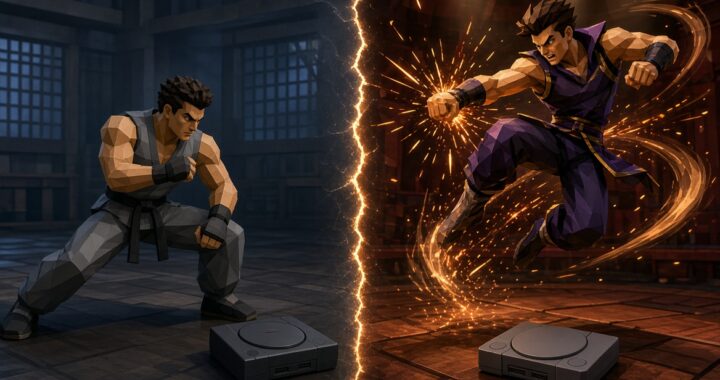
When 3D fighting games took over the world, Sega’s Virtua Fighter was the undisputed pioneer. But another titan was quietly sharpening its blades in Namco’s development studios: Tekken.
Over the course of three legendary releases in the 90s, Tekken transformed from what many initially dismissed as a simple 3D clone into the most thrilling, adrenaline-pumping fighting franchise on Earth.
Central to this transformation was a revolutionary execution mechanic that reshaped how we approached combat: The 10-String Combo (10단 콤보).
Here is the story of living through Tekken 1, experiencing the sheer disbelief of Tekken 2’s move lists, and feeling the unmatched euphoria of executing flawless 10-String sequences in Tekken 3.
1. Tekken 1 (1994): The Initial Impression of a “Virtua Fighter Clone”
When Namco unveiled the original Tekken on their System 11 arcade hardware in late 1994, the initial reaction from seasoned arcade dwellers was cautious skepticism.
+--------------------------------------------------------------------------+
| TEKKEN 1 (1994) |
| Initial Impression: A blocky challenger in Virtua Fighter's shadow |
| Key Innovation: 4-button limb control layout (LP, RP, LK, RK) |
+--------------------------------------------------------------------------+
Having already been captivated by Sega’s Virtua Fighter, many players looked at Tekken 1 and saw a follower rather than a leader. Its blocky polygons and exaggerated jump physics seemed to borrow heavily from Sega’s blueprint.
However, beneath the surface lay a crucial innovation that set it apart: the four-button limb system.
By assigning each face button to a specific limb—Left Punch, Right Punch, Left Kick, Right Kick—Namco laid the groundwork for an intuitive, rhythm-based execution style that felt distinctly different from Sega’s 3-button layout.
2. Tekken 2 (1995): The “10-String Combo” Disbelief
In 1995, Tekken 2 stormed into arcades, completely obliterating any remaining doubts about the franchise. It featured smoother character models, iconic music, and a roster packed with colorful personalities like Kazuya Mishima, Heihachi, Paul Phoenix, and King.
It was also the era when arcade cabs began featuring printed Move Lists (기술표) side-by-side on the control panel marquee.
+-------------------------------------------------------------------------+
| THE 10-STRING COMBO SHOCK |
| Printed Move List: [LP, RP, LP, RP, LK, RK, LP, RP, LP, RP] |
| Player Reaction: "Wait... ALL of these inputs connect in ONE sequence?!" |
+-------------------------------------------------------------------------+
The Disbelief at the Marquee
Staring at the Tekken 2 cabinet marquee for the first time was a jaw-dropping moment. Nestled at the bottom of each character’s move list was a daunting sequence of 10 consecutive button presses labeled as the 10-String Combo.
We stared at the panel in sheer disbelief: “Do all ten of these inputs really chain together into one uninterrupted, devastating combination?”
Testing it out in an actual match was mind-blowing. Hearing the rhythm of sequential hits connecting—accompanied by Namco’s crunching hit-sparks—proved that Tekken was no longer just a 3D fighter; it was a rhythmic instrument of martial destruction.
3. Tekken 3 (1997): The Peak of Muscle Memory and Arcade Euphoria
By the time Tekken 3 debuted on Namco’s System 12 hardware in 1997, the game had achieved absolute perfection. With dynamic sidestepping, lightning-fast 60 FPS movement, and new icons like Jin Kazama, Hwoarang, and Eddy Gordo, it became a global cultural phenomenon.
For dedicated players, Tekken 3 was the ultimate test of execution. We spent countless hours studying frame data, memorizing character-specific 10-String Combos, and practicing high-damage infinite/juggle setups.
+-------------------------------------------------------------------------+
| TEKKEN 3 EXECUTION MASTERY |
| The Setup: Counter-hit launcher or round-opening pressure |
| The Execution: Rhythmic precision, precise timing, no dropped inputs |
| The Payoff: Watching your opponent's health bar melt away in real time |
+-------------------------------------------------------------------------+
The Pure Rush of Real-Match Execution
There was no feeling in the 1990s arcade quite like trapping an opponent in a real-world match and unleashing a fully memorized 10-String Combo or infinite string.
- The Physical Rhythm: As your fingers danced across the four arcade buttons with machine-gun speed, you felt the tactile click of the microswitches matching the rhythm on screen.
- The Opponent’s Panic: Watching the player sitting across or beside you panic as their character was locked into high-damage hit-stun was pure psychological dominance.
- The Final Hit: Landing the 10th and final blow to shatter their guard, take the round, and force them to reach back into their pocket for another quarter was an unparalleled rush of dopamine.
Summary Matrix: The Evolution of Tekken’s Mastery
| Game Title | Arcade Hardware | Initial Perception | Defining Execution Memory |
| Tekken 1 (1994) | Namco System 11 | Viewed as a Virtua Fighter follower | Learning the 4-button limb layout |
| Tekken 2 (1995) | Namco System 11 | Recognized as an arcade titan | Shock and awe at the 10-String printed move lists |
| Tekken 3 (1997) | Namco System 12 | The undisputed King of 3D Fighters | The adrenaline rush of landing full 10-String combos in matches |
Conclusion: The Unmatched Spirit of 90s Arcade Rivalries
Looking back, Tekken’s journey from a modest 3D contender to the undisputed king of fighting games is one of the greatest success stories in gaming history.
While Virtua Fighter taught us respect for spatial 3D physics, Tekken gave us the thrill of execution, character expression, and the intoxicating sensation of mastering complex combo mechanics.
For anyone who spent their teenage years in a noisy, neon-lit 1990s arcade, the memory of memorizing those 10-String Combos and executing them under pressure against a challenger remains a badge of honor that time can never erase.
Frequently Asked Questions (FAQ)
Q1: Can 10-String Combos in Tekken be blocked?
Yes! Unlike air juggles, 10-String Combos are grounded sequences that alternate between high, mid, and low attacks. Experienced players can crouch or low-parry specific hits within the sequence to interrupt the combo and punish the attacker.
Q2: What made Tekken 3 so much faster than Tekken 1 and 2?
Namco completely revamped the movement system in Tekken 3 by reducing jump heights, introducing true 3D sidestepping into the background/foreground, and running the game engine at a rock-solid 60 frames per second on upgraded System 12 arcade hardware.
Join the Discussion
Which character’s 10-String Combo did you learn first in Tekken 2 or Tekken 3? Were you a Jin, Paul, King, or Law main back in the arcade days? Share your favorite memories in the comments below!
