The Playstation Revolution: How Sony Disrupted Nintendo and Changed Gaming Forever
Introduction: A Betrayal That Rewrote Gaming History
In September 1995, the North American video game industry experienced a seismic shift from which it would never return. For over a decade, Nintendo had held an ironclad grip on the home console market, defining what video games looked like, sounded like, and how they were distributed.
However, a fateful corporate rift in the early 1990s set the stage for one of the greatest revenge stories in business history.
Originally, Sony had partnered with Nintendo to develop a CD-ROM add-on for the Super Nintendo Entertainment System (SNES)—a project codenamed the “Play Station.” But after Nintendo abruptly canceled the contract due to licensing disagreements, Sony executive Ken Kutaragi persuaded Sony’s leadership to build an independent, standalone gaming console.
On September 9, 1995, the original Sony PlayStation (PS1) launched in North America for $299—a iconic price point announced with legendary brevity by Steve Race at E3 1995 that instantly undercut the $399 Sega Saturn.
The launch of the PS1 did not just bring new hardware to retail shelves; it completely shattered Nintendo’s dominance, fundamentally transformed game publishing, and shifted video games from children’s toys into mainstream adult pop culture.
1. The Media Revolution: CD-ROMs vs. ROM Cartridges
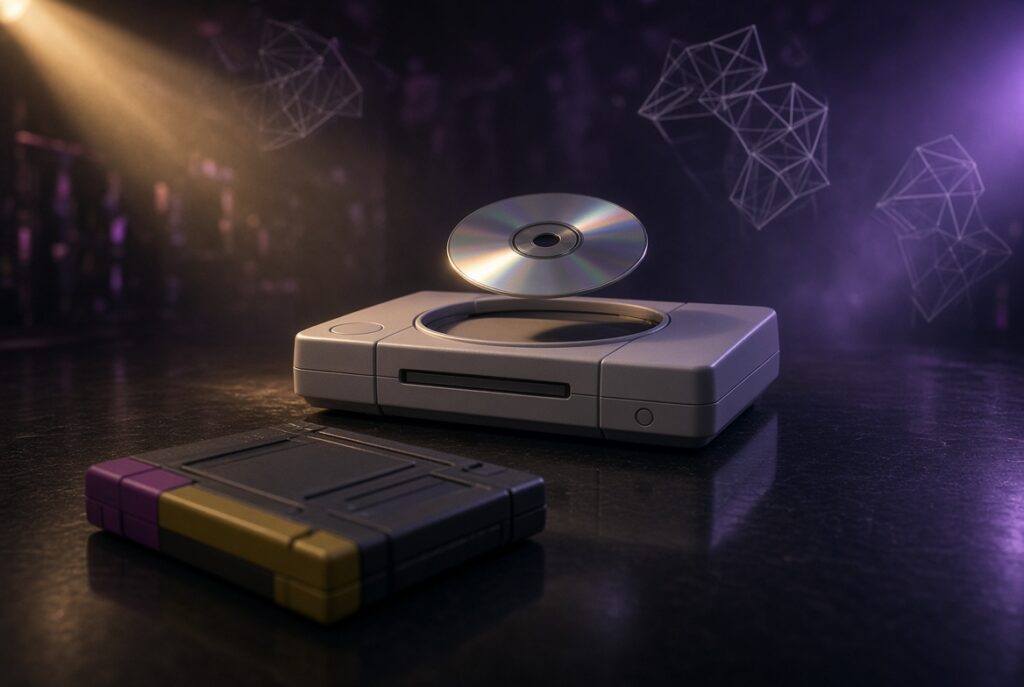
The primary battleground between Sony and Nintendo came down to media format. While Nintendo stubbornly insisted on using silicon ROM cartridges for its upcoming Nintendo 64, Sony placed its entire future on CD-ROM technology.
+--------------------------------------------------------------------------+
| CARTRIDGE VS. CD-ROM (CIRCA 1995)                                         |
| Nintendo Cartridge: ~64 MB Max | High Manufacturing Cost | Instant Load  |
| Sony PS1 CD-ROM:    ~650 MB     | Ultra-Low Cost ($1/disc)| Rich Audio/FMV|
+--------------------------------------------------------------------------+
Why Developers Abandoned Nintendo for Sony
- Massive Storage Capacity: A single PlayStation CD-ROM stored up to 650 Megabytes of data—more than ten times the storage capacity of early N64 cartridges. This allowed developers to include orchestrated music, full-motion video (FMV) cutscenes, and extensive voice acting.
- Economic Flexibility: Manufacturing a Nintendo cartridge took up to two months and cost publishers around $30–$40 per unit. Producing a PlayStation CD took less than a week and cost roughly $1 per disc.
- Low Risk for Publishers: Low production costs meant publishers could take bold creative risks on niche genres without facing bankruptcy if a game failed to sell out its initial print run.
2. The Great Migration: Final Fantasy VII and Third-Party Support
The economic and technical advantages of the CD-ROM format triggered an unprecedented exodus of top-tier third-party developers from Nintendo to Sony.
The turning point came when Square (now Square Enix) famously abandoned its decade-long loyalty to Nintendo to develop Final Fantasy VII exclusively for the PlayStation.
+-------------------------------------------------------------------------+
| THE FINAL FANTASY VII EFFECT (1997)                                     |
| Spanned 3 CD-ROM discs filled with pre-rendered 3D backgrounds,          |
| cinematic FMV sequences, and a sweeping orchestral soundtrack.           |
| Sold over 10 million copies, cementing PS1 as the RPG capital of home gaming.|
+-------------------------------------------------------------------------+
When Final Fantasy VII launched in 1997, it proved that games could tell emotionally complex, cinematic stories that rivaled Hollywood blockbusters—something that was technically impossible on a 64MB Nintendo cartridge.
Publishers like Capcom (Resident Evil), Konami (Metal Gear Solid, Silent Hill), and Namco (Tekken) quickly followed suit, creating iconic franchises that defined the 32-bit era on PlayStation.
3. Redefining the Target Audience: From “Toys” to “Pop Culture”
Before the PlayStation, video games in North America were heavily marketed toward children and young teenagers, often stocked strictly in toy aisles. Sony completely reimagined the target demographic.
The College & Club Culture Marketing
Sony recognized that the generation that grew up with the NES and SNES had matured into young adults in their late teens and 20s. Sony’s marketing team, led by figures like Andrew House and Phil Harrison, aggressively targeted night clubs, music festivals, and college campuses.
- Edgy Commercial Campaigns: Ads like “UR Not e” and dark, surreal television spots positioned the PlayStation as a lifestyle fashion statement rather than a toy.
- DualShock Controller: Released in 1997, the DualShock controller introduced dual analog sticks and dual vibration motors, establishing the universal twin-stick control scheme still used across all modern platforms today.
4. Architectural Shift: The 3D Polygon Renaissance
While Nintendo’s hardware was renowned for colorful 2D tilemaps, the PlayStation was engineered from the ground up to render real-time 3D textured polygons.
The console’s dedicated Geometry Transformation Engine (GTE) allowed developers to create vast, fully navigable 3D environments.
| Key PlayStation Franchise | Genre | Architectural Innovation |
| Tekken / Tekken 3 | Fighting | True 3D fighter with smooth 60fps polygon character models |
| Resident Evil | Survival Horror | 3D real-time character models over cinematic pre-rendered backgrounds |
| Metal Gear Solid | Tactical Stealth Action | Fully 3D environments featuring dynamic camera angles and cinematic cuts |
| Gran Turismo | Racing Simulator | Photorealistic vehicle physics and reflective lighting shaders |
| Crash Bandicoot | 3D Platformer | Pushed hardware limits using custom vertex animation code |
5. The Commercial Triumph: Breaking the 100-Million Barrier
By the end of its lifecycle, the original PlayStation had accomplished what many thought impossible in 1995:
- It became the first video game console in history to ship over 100 million units worldwide (102.49 million units total).
- It reduced Nintendo’s home console market share significantly, as the Nintendo 64 sold roughly 32.93 million units in comparison.
- It established Sony as the premier force in interactive entertainment—a legacy that continues through the PlayStation 2, 3, 4, and 5 today.
Conclusion: The Era That Changed Everything
The launch of the Sony PlayStation in September 1995 was far more than a hardware debut; it was the birth of modern gaming as we know it today.
By combining low-cost CD-ROM storage, aggressive developer-friendly licensing, cutting-edge 3D polygonal graphics, and mature lifestyle marketing, Sony permanently shifted the center of power away from Nintendo’s traditional model.
For retro gaming enthusiasts, collectors, and historians, the original PS1 stands as a monumental monument to innovation—the system that proved video games were not a passing children’s fad, but the defining artistic medium of the 21st century.
Frequently Asked Questions (FAQ)
Q1: Why did Nintendo stick with cartridges for the Nintendo 64 instead of CDs?
Nintendo favored cartridges because they eliminated long loading screens, were virtually indestructible, and prevented piracy. Furthermore, Nintendo earned higher profit margins on proprietary cartridge manufacturing, though this ultimately alienated third-party developers.
Q2: What was the famous “$299” announcement at E3 1995?
At the inaugural E3 convention in May 1995, Sega announced that the Sega Saturn was available immediately for $399. Shortly after, Sony executive Steve Race took the stage, uttered only “299,” and walked off—instantly undercutting Sega by $100 and securing a massive competitive edge prior to launch.
Join the Discussion
Do you remember the first time you saw a 3D PlayStation game running on a CRT television? Did you own a PS1 or an N64 during the late 90s console wars? Share your memories in the comments below!
\ Get the latest news /
