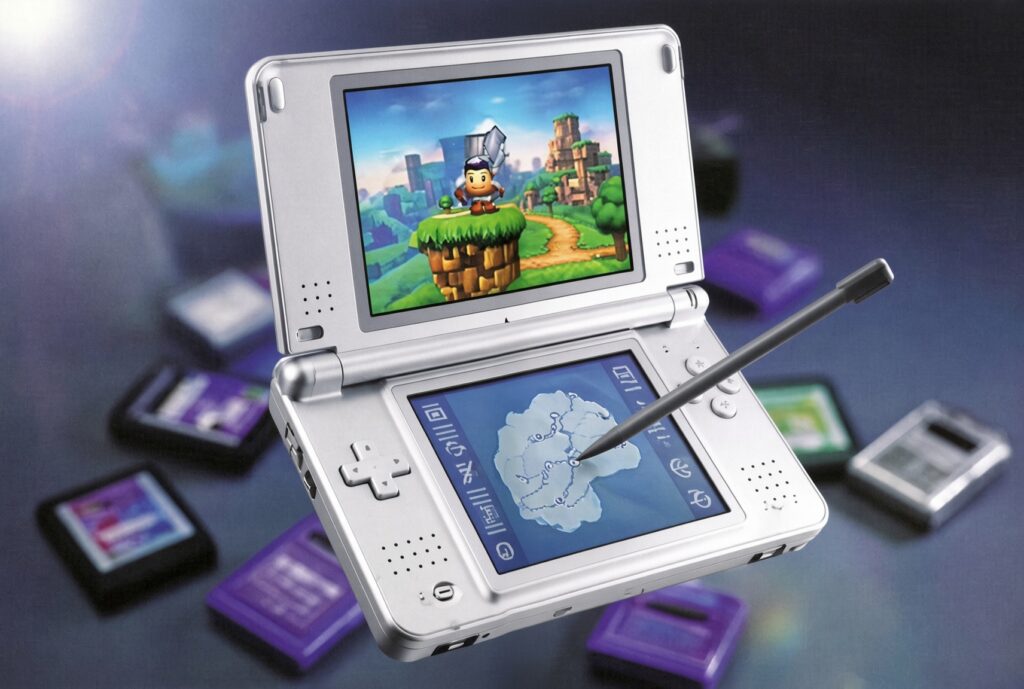
Two Screens, Infinite Possibilities: Inside the 2004 North American Nintendo DS Launch
Introduction: The Dual-Screen Revolution Begins
On November 21, 2004, Nintendo launched a hardware experiment that many industry analysts initially viewed with skepticism. Arriving in North America ahead of both Japan and Europe, the Nintendo DS (NDS) introduced a bold new philosophy to handheld gaming: “Developers System” and “Dual Screen.”
Equipped with dual 3-inch backlit LCD screens, an integrated resistive touch panel on the bottom screen, a built-in microphone, and embedded Wi-Fi for wireless local multiplayer, the DS moved away from simple button-mashing to intuitive, tactile interactions.
Powered by twin processors—an ARM946E-S running at 67 MHz alongside an ARM7TDMI at 33 MHz—the console possessed the 3D rendering capabilities to easily surpass the 32-bit era, bringing full 3D polygonal worlds to portable gaming.
To launch the system in North America, Nintendo and third-party partners debuted a 12-game launch lineup.
By pairing a flagship 3D Mario platformer with eccentric touch-driven puzzles, realistic urban simulators, and high-speed racers, Nintendo proved that two screens were infinitely better than one. Here is your ultimate guide to the historic games that launched the Nintendo DS.
1. The Crown Jewel: Super Mario 64 DS
Leading the DS launch as the premier must-have flagship title was Super Mario 64 DS, a comprehensive 3D remake and expansion of the revolutionary 1996 Nintendo 64 classic.
+--------------------------------------------------------------------------+
| SUPER MARIO 64 DS (2004)                                                 |
| Developer / Publisher: Nintendo EAD / Nintendo                           |
| Key Innovations: 4 playable characters (Yoshi, Mario, Luigi, Wario),    |
| 30 additional Power Stars (150 total), stylus Touch-Slinger controls,    |
| and dozens of touch-screen mini-games unlocked via Silver Rabbits.       |
+--------------------------------------------------------------------------+
Why It Proved 3D Portable Gaming Was Real
Super Mario 64 DS served as the ultimate proof-of-concept for the system’s raw 3D polygon processing power.
Instead of starting as Mario, players began their quest as Yoshi, rescuing Mario, Luigi, and Wario throughout the game—each character featuring unique physical attributes, such as Luigi’s high jumps or Wario’s ground-pounding strength.
The bottom touch screen served dual functions: acting as a real-time mini-map and radar during main exploration, while offering an analog-style Virtual Touch D-Pad when using the system’s included wrist-strap thumb pad.
2. Quirky Touch-Screen Magic: Feel the Magic: XY/XX
If Super Mario 64 DS showcased 3D graphics, Sega’s Feel the Magic: XY/XX (known in Japan as Kimi no Tame Nara Shineru) was the ultimate ambassador for the stylus, touch screen, and microphone.
Developed by Sonic Team, this stylistically avant-garde minigame collection put players in the role of a young man attempting to win the heart of a girl by completing wildly creative, fast-paced minigames:
- Touch & Drag Physics: Players scrubbed scorpions off the heroine using the stylus, swiped to pull swallowed goldfish out of a character’s stomach, or tapped to deflect bowling balls.
- Microphone Interaction: Players blew into the DS microphone to inflate balloons or sail a boat across stormy waters.
Its silhouette art style, catchy pop soundtrack, and quirky humor instantly turned Feel the Magic into a cult classic launch hit.
3. High-Velocity Urban Racing: Asphalt Urban GT and Ridge Racer DS
Racing enthusiasts were treated to two distinct perspectives on portable 3D racing on day one.
Asphalt Urban GT (Gameloft / Ubisoft)
Asphalt Urban GT brought licensed real-world sports cars (including Aston Martin, Lamborghini, and Audi) to portable screens. The bottom screen acted as a detailed secondary dashboard showing real-time GPS track telemetry, turbo boost meters, and police radar alerts while high-speed racing unfolded on the top screen.
Ridge Racer DS (Namco)
Namco brought its premier arcade racing franchise to the platform, offering smooth 3D drift physics across classic tracks. Ridge Racer DS allowed players to steer their vehicle directly on the bottom screen using a virtual steering wheel controlled with the stylus.
4. Puzzle Perfection: Polarium and Mr. Driller: Drill Spirits
The dual-screen architecture created a natural sanctuary for innovative puzzle design.
Polarium (Nintendo / Mitchell Corporation)
A minimalist, zen-like tile puzzle game where players drew a continuous line with the stylus across the bottom grid to flip black and white tiles. Clearing rows required strategic spatial planning, making Polarium an addictive companion for daily commutes.
Mr. Driller: Drill Spirits (Namco)
Namco’s frantic puzzle-action game utilized the dual screens seamlessly to render a continuous vertical digging shaft. As players drilled down through falling colored blocks, they could look up at the top screen to anticipate falling obstacles well before they impacted their driller.
5. Overview: The Full November 2004 North American NDS Launch Library
The November 21, 2004 launch library offered 12 titles spanning diverse genres:
| Game Title | Genre | Publisher | Key Feature / Legacy |
| Super Mario 64 DS | 3D Platformer | Nintendo | Expanded N64 remake with 4 playable characters |
| Feel the Magic: XY/XX | Minigame / Action | Sega | Innovative stylus, touch, and microphone mechanics |
| Asphalt Urban GT | 3D Racing | Ubisoft | Licensed real-world sports cars and touch GPS telemetry |
| Ridge Racer DS | Arcade Racing | Namco | Touch-screen virtual steering wheel controls |
| Polarium | Line-Drawing Puzzle | Nintendo | Minimalist line-flip puzzle mechanics |
| Mr. Driller: Drill Spirits | Action Puzzle | Namco | Dual-screen vertical digging gameplay |
| Madden NFL 2005 | Sports Simulation | EA Sports | Touch-screen playbook calling and field goal kicks |
| URBZ: Sims in the City | Life Simulation | EA Games | Stylus menu management and custom character design |
| Ping Pals | Social / Chat | THQ | Virtual avatar customization and mini-game messaging |
| Spider-Man 2 | Action / Platformer | Activision | Touch-screen web-swinging and side-scrolling action |
| Super Monkey Ball Touch & Roll | Puzzle / Action | Sega | Stylus-guided ball rolling physics |
| Demon Driver: Time to Burn | Combat Racing | Majesco | Fast-paced arena vehicular combat |
The Legacy of the Nintendo DS Launch
The November 2004 North American launch of the Nintendo DS was more than just a new console release—it marked the beginning of tactile, touch-first gaming years before smartphones transformed mobile technology.
By daring to break away from traditional single-screen button controls, Nintendo established a hardware ecosystem that would eventually go on to sell over 154 million units worldwide, becoming the second best-selling video game system in history.
For retro collectors, gaming historians, and enthusiasts today, returning to these 12 original North American launch cartridges offers a fascinating look at the birth of dual-screen innovation.
Frequently Asked Questions (FAQ)
Q1: Could the original Nintendo DS play Game Boy Advance cartridges?
Yes! The original Nintendo DS (model NTR-001) and the Nintendo DS Lite featured a secondary hardware slot (Slot-2) at the bottom, offering 100% hardware backward compatibility with Game Boy Advance titles.
Q2: What was PictoChat, and was it included at launch?
PictoChat was a built-in wireless communication application embedded directly into the Nintendo DS system memory. Included free out of the box at launch, it allowed up to 16 nearby DS users in local wireless range to draw, type, and share visual messages with each other without needing a game cartridge.
Join the Discussion
Which of the 12 original North American Nintendo DS launch titles did you unbox first back in November 2004? Did you spend more time collecting stars in Super Mario 64 DS or drawing in PictoChat? Share your nostalgia in the comments below!
\ Get the latest news /
