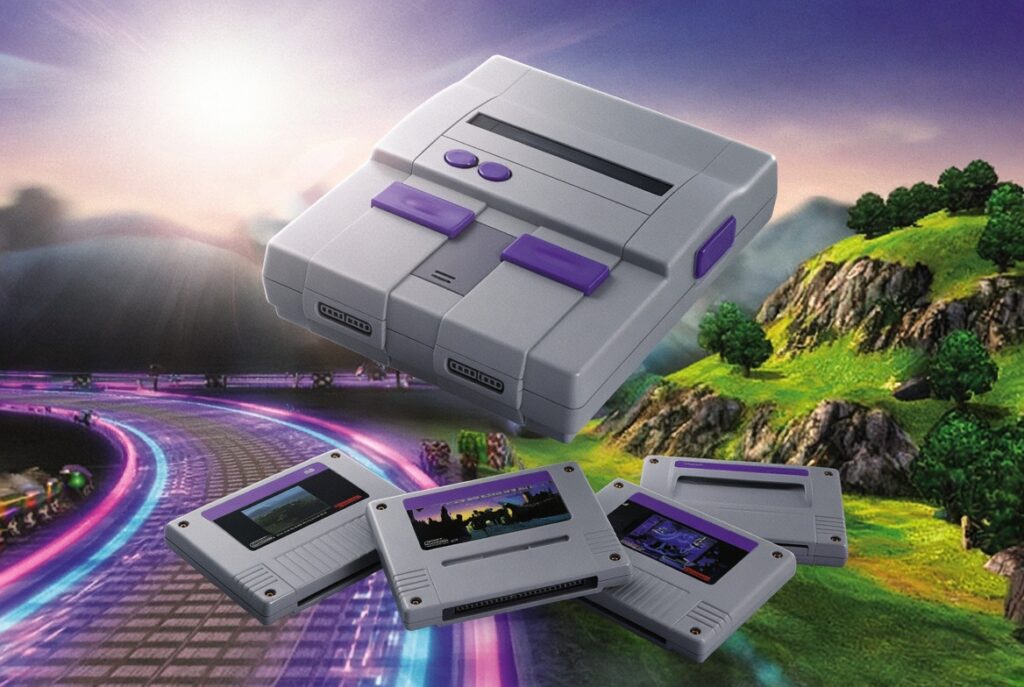
The 16-Bit Counterattack: Introducing the Historic SNES Launch Titles
Introduction: The Arrival of Nintendo’s 16-Bit Powerhouse
In August 1991, the North American home video game market was at a critical turning point. Sega had gained immense momentum with its aggressive “Blast Processing” campaigns, positioning the Sega Genesis as the edgy, high-speed alternative to the aging 8-bit NES.
Nintendo, however, was preparing its ultimate response. On August 23, 1991, Nintendo officially launched the Super Nintendo Entertainment System (SNES) in North America.
Where Sega emphasized raw CPU clock frequency, Nintendo constructed a hardware architecture built for unmatched visual depth and rich audio synthesis. Boasting a 32,768-color palette (with up to 256 colors on screen simultaneously), hardware-level sprite scaling and rotation (known as Mode 7), and an 8-channel Sony audio chip, the SNES brought unprecedented cinematic polish into living rooms.
To demonstrate this technological leap, Nintendo released the SNES alongside five legendary launch titles.
From defining 2D platforming perfection to pioneering 3D perspective racing, these games proved that the 16-bit era had truly arrived. Here is your ultimate guide to the games that launched the Super Nintendo.
1. The Crown Jewel: Super Mario World
Leading the SNES launch as the official pack-in title bundled with the console was Super Mario World, designed by Shigeru Miyamoto and Takashi Tezuka.
+--------------------------------------------------------------------------+
| SUPER MARIO WORLD (1991)                                                 |
| Genre: 2D Side-Scrolling Platformer                                      |
| Key Innovations: World Map secret exits, introduction of Yoshi,          |
| multi-layered background parallax, dynamic camera scaling and spin-jumps.|
+--------------------------------------------------------------------------+
Why It Redefined Platforming Again
Following the groundbreaking success of Super Mario Bros. 3 on the NES, Super Mario World took full advantage of the SNES’s expanded memory and color depth.
The game introduced Yoshi, Mario’s dinosaur companion, who brought unique mechanics like swallowing enemies, spitting fireballs, and granting specialized flight abilities depending on the color of shell he consumed.
With 96 exits scattered across Dinosaur Land, vibrant background art, and Koji Kondo’s dynamic, multi-instrumental soundtrack, Super Mario World set a gold standard for level design that remains influential to this day.
2. Speed and Mode 7 Mastery: F-Zero
If Super Mario World showcased color depth and gameplay mechanics, F-Zero was designed to flex the raw graphic processing muscle of the SNES hardware.
The Mode 7 Revolution
Before 3D graphics cards existed in home consoles, F-Zero introduced players to Mode 7—a hardware feature that allowed a flat 2D background layer to be scaled, rotated, and tilted in real-time.
By flattening a high-resolution racetrack map onto the screen and rotating it beneath the player’s hovering vehicle, F-Zero simulated a pseudo-3D perspective at blistering speeds.
- Futuristic High-Speed Racing: Set in the year 2560, players piloted hover-cars like the Blue Falcon across lethal plasma-track courses at speeds exceeding 400 km/h.
- Chiptune Masterclass: The game’s energetic electronic soundtrack (featuring legendary tracks like Mute City and Big Blue) highlighted the rich basslines and synthesizer capabilities of the SNES audio chip.
3. Atmospheric Action: Super Castlevania IV
Konami’s Castlevania series was already a household name on the 8-bit NES, but Super Castlevania IV leveraged the 16-bit hardware to transform the franchise into an atmospheric gothic masterpiece.
+-------------------------------------------------------------------------+
| SUPER CASTLEVANIA IV (1991)                                             |
| Feature 1: 8-Directional Whip Control & Swinging Physics                |
| Feature 2: Rotating Mode 7 room environments and background scaling     |
| Feature 3: Orchestral ADPCM audio with dynamic ambient echo effects     |
+-------------------------------------------------------------------------+
Reimagining Simon Belmont’s Quest
Super Castlevania IV was more than a sequel; it was a complete technological reimagining of Simon Belmont’s crusade against Dracula.
- Whip Physics: Players could now swing their whip in eight distinct directions, block incoming enemy projectiles, and hook onto ceiling rings to swing across chasms.
- Visual Spectacle: Level 4-2 famously featured an entire room that rotated 360 degrees in the background using Mode 7 processing while Simon swung from a central ring, mesmerizing gamers in 1991.
4. High-Altitude Flight: Pilotwings
Co-developed by Nintendo EAD, Pilotwings served as a technical showcase for the SNES’s rotation, scaling, and vector math capabilities.
Acting as a flight simulation training academy, players completed challenges in hang gliding, skydiving, rocket belting, and biplane flight.
- Depth Perception via Scaling: As players plummeted toward target landing pads during skydiving missions, the island terrain scaled smoothly toward the camera, demonstrating the console’s ability to calculate dynamic scale and perspective without frame drops.
5. Tactical Sci-Fi Strategy: Gradius III
Rounding out the North American launch lineup was Konami’s iconic space shooter, Gradius III.
A direct port of the demanding arcade game, Gradius III allowed players to customize their ship’s weapon loadout (the Vic Viper) with specialized laser beams, shields, and option pods.
- Arcade Visuals at Home: The game displayed massive boss alien battles and multi-layered starfield parallax scrolling.
- Historical Context: While early levels suffered from hardware slowdown when dozens of enemy projectiles flooded the screen, Gradius III proved that complex arcade shoot-’em-ups could be played in living rooms without sacrificing graphic detail.
6. Summary Matrix: The 1991 North American SNES Launch Lineup
| Game Title | Genre | Developer / Publisher | Key Technical Feature / Legacy |
| Super Mario World | 2D Platformer | Nintendo EAD / Nintendo | Official pack-in game; introduced Yoshi and 96 exits |
| F-Zero | Futuristic Racer | Nintendo EAD / Nintendo | Showcased Mode 7 pseudo-3D racetrack rotation |
| Super Castlevania IV | Action Platformer | Konami | 8-way whip mechanics and rotating Mode 7 rooms |
| Pilotwings | Flight Simulator | Nintendo EAD / Nintendo | Flight physics and smooth terrain sprite scaling |
| Gradius III | Shoot ‘Em Up | Konami | Massive arcade boss sprites and custom weapon loadouts |
Conclusion: The Legacy of August 1991
While five games may seem like a modest launch selection, Nintendo prioritized uncompromising quality over quantity.
Each title in the August 1991 launch lineup had a specific purpose: Super Mario World guaranteed unmatched gameplay depth, F-Zero and Pilotwings showcased revolutionary Mode 7 graphics processing, Super Castlevania IV demonstrated atmospheric 16-bit audio, and Gradius III delivered hardcore arcade thrills.
This small but potent library successfully ignited the SNES era, laying the groundwork for a platform that would go on to host some of the greatest video games ever made.
Frequently Asked Questions (FAQ)
Q1: Was Legend of Zelda: A Link to the Past an SNES launch title in North America?
No. While A Link to the Past launched in Japan in November 1991, the North American version was not released until April 1992.
Q2: Did all 5 launch titles come bundled with the console?
No. Only Super Mario World was included as a pack-in game with the standard SNES console set in August 1991. The remaining four titles had to be purchased separately at retail.
Join the Discussion
Which of the five original North American SNES launch titles did you play first? Do you still remember seeing F-Zero’s Mode 7 graphics for the first time? Share your nostalgic memories in the comments below!
\ Get the latest news /
