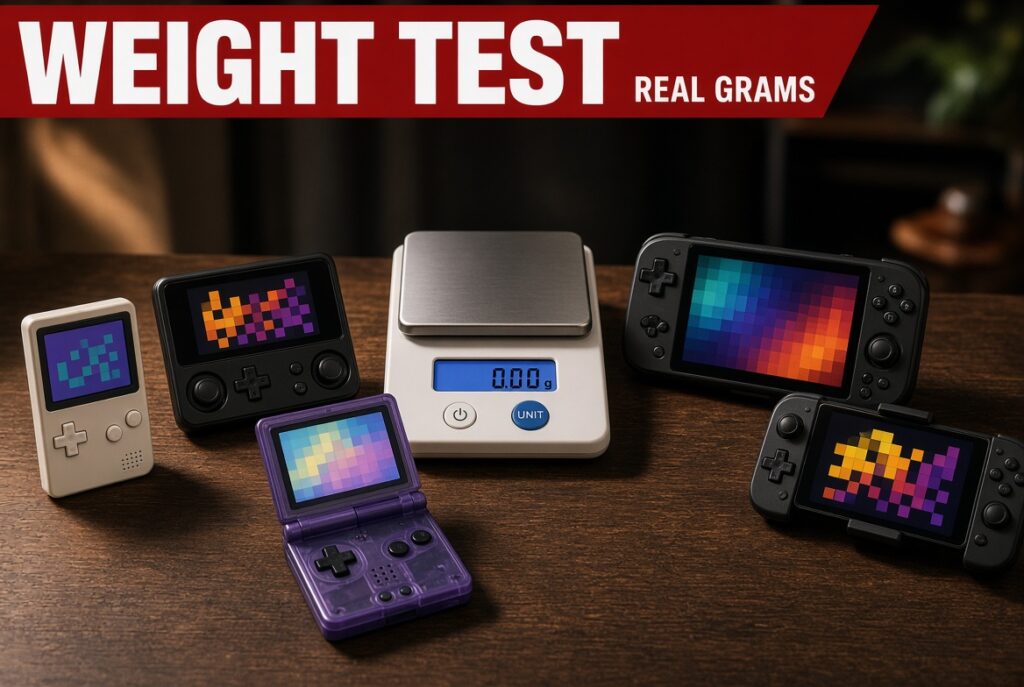
I Put 15 Retro Handhelds on a Kitchen Scale. Your Wrists Are Going to Hate One of Them.
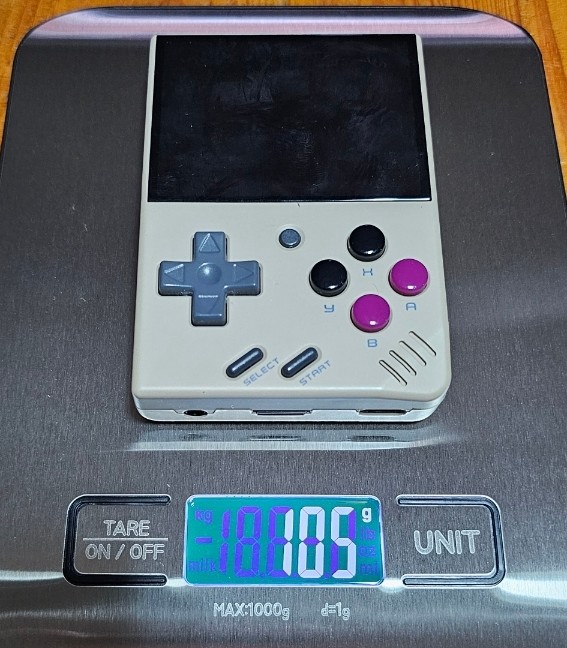
Spec sheets lie in the friendliest way possible. A listing says “180g.” You order it. It shows up. And after one subway ride of Chrono Trigger, your thumb joint is filing a complaint.
Weight is the spec most buyers skip and the one they feel first. Screen size looks great in photos. Chipsets look great on Reddit. Grams show up in your hands at 11 p.m. when you swore you were only going to play “one more dungeon.”
So I lined up the handhelds I actually own, dropped them on a scale, and wrote the numbers down. Official listings are included where they disagree. If you want a device you will keep carrying, start here — not with another “best handheld of 2026” list that ignores your tendons.
Why weight matters more than the chipset (for most people)
A lot of first-time buyers chase performance. Fair. If you want PlayStation 2 and GameCube, you need horsepower. But most people who get into this hobby spend 80% of their time on Game Boy, SNES, Genesis, GBA, and PS1. Those systems do not need a 15-ounce slab.
Weight changes three things:
- Pocket vs. bag. Under about 7 ounces, a device disappears in a jacket. Over 9 ounces, it wants a sling bag.
- Session length. Light devices get used on the couch, in bed, and in line at Target. Heavy devices become “weekend only.”
- Wrist and thumb strain. Combine a heavy body with a phone-grip controller and you are asking for a break every few minutes.
For context Americans already know: a deck of cards is about 3.3 ounces. An iPhone 15 Pro is about 6.6 ounces. A Nintendo Switch Lite is 8.5 ounces. A Steam Deck LCD is a brick at roughly 1.5 pounds. Retro handhelds live all over that range.
The real scale numbers
These are on-device measurements from one collection, not catalog copy. Converted to ounces for U.S. readers. Official listed weights are noted when they differ.
| Device | Measured | Ounces | What it feels like |
|---|---|---|---|
| Miyoo Mini V1 | 105 g | 3.7 oz | A deck of cards with buttons |
| Razer Kishi V2 (controller only) | 123 g | 4.3 oz | Clip-on, not a console |
| Powkiddy RK2023 (Pure Black) | 176 g | 6.2 oz | Surprisingly light |
| Anbernic RG34XX SP | 180 g | 6.3 oz | Clamshell that still travels |
| Anbernic RG35XX H | 185 g | 6.5 oz | Listing often says 180 g |
| BATLEXP G350 | 189 g | 6.7 oz | Light, clicky buttons |
| R36S | 191 g | 6.7 oz | Budget vertical, still pocketable |
| XU10 | 200 g | 7.1 oz | The “I can feel it” line |
| Anbernic RG40XX H | 201 g | 7.1 oz | Bigger screen, still carryable |
| Anbernic RG351V | 229 g | 8.1 oz | Vertical with real mass |
| Samsung Galaxy S23 Ultra | 239 g | 8.4 oz | Phone-as-console baseline |
| Trimui Smart Pro | 259 g | 9.1 oz | Big screen tax |
| Retroid Pocket 4 Pro | 274 g | 9.7 oz | Performance starts costing grams |
| Mid-size Android handheld (~OGS class) | 275 g | 9.7 oz | Same neighborhood as RP4 Pro |
| Retroid Pocket 5 | 282 g | 9.9 oz | Still reasonable for the power |
| Galaxy S23 Ultra + Kishi V2 | 362 g | 12.8 oz | Phone + grip = workout |
| AYN Odin 2 (typical listed) | ~420 g | 14.8 oz | Powerful, not pocketable |
Two accessory notes that listings never mention:
- Retroid Pocket 3+ grip add-on: 71 g
- Retroid Pocket 2S grip add-on: 54 g
Grips help comfort. They also quietly push a “light” handheld into the next weight class.
The three weight classes that actually matter
Featherweight: under 6.5 ounces
Miyoo Mini V1 is the joke of the group in the best way. At 3.7 ounces it feels unfinished until you play it. This is the device you throw in a jeans pocket and forget. It is also the device that makes SNES and Game Boy feel like 1998 again, because you are holding almost nothing.
The RG34XX SP lands here too as a clamshell. Folded, the screen is protected. That matters more than people admit if the handheld lives in a bag with keys.
Best for: commuters, parents who game in five-minute bursts, anyone who already abandoned a heavy device.
Daily driver: 6.5 to 8 ounces
This is the sweet spot. RG35XX H at 185 g / 6.5 oz is the one I keep coming back to for everything through PS1. Horizontal layout, analog sticks, stereo speakers, and it still feels closer to a phone than a gadget.
RK2023, G350, R36S, XU10, and RG40XX H all live in this band. Once you cross 200 g / 7.1 oz, you notice it. Not painful. Just present. RG351V at 8.1 ounces is where “I’ll bring it” starts turning into “I’ll leave it on the nightstand.”
Best for: most people buying their first or second handheld.
Performance class: 9 ounces and up
Trimui Smart Pro, Retroid Pocket 4 Pro, Retroid Pocket 5 — these are the “I want a bigger screen and later systems” machines. They are not uncomfortable. They are just not the thing you forget is in your coat.
Then there is the phone experiment. A Galaxy S23 Ultra (8.4 oz) plus a Kishi V2 (4.3 oz) totals 12.8 ounces. That combo can play a lot. It also cooks your hands. If you go this route, stand up and shake your wrists out every five minutes. I am not being cute. Tendons do not care that the emulator is free.
AYN Odin 2 sits near 15 ounces. For PS2, PSP, GameCube, and Dreamcast, that weight is the cost of admission. The chip can do the work. Your commute bag has to do the carrying.
A two-device setup that actually makes sense
You do not need one handheld that “does everything.” That device will be heavy, expensive, and used less than you think.
The split that works in real life:
- PS1 and older: Anbernic RG35XX H (6.5 oz). Cheap, light, instant pickup.
- PS2, PSP, GameCube, Dreamcast: AYN Odin 2 at home or in a backpack.
That is the whole strategy. Light device for the games you play every day. Heavy device for the games that need it. Same logic as keeping a daily driver hatchback and renting a truck when you move a couch.
If you only buy one device and your library stops at SNES and GBA, buy light. If your dream is Shadow of the Colossus on the couch, buy power and accept the ounces.
Official listings vs. the scale
Anbernic’s RG35XX H is often listed at 180 g. On the scale it was 185 g. Five grams will not ruin your life. It is a reminder that product pages round, omit grips, and ignore screen protectors and SD cards.
If a store listing and a review disagree by 10–20 grams, believe the review with a photo of a scale. Batteries, glass, and analog-stick modules add up.
Comfort rules that beat any buying guide
- If it is over 9 ounces, plan a bag, not a pocket.
- Clamshells protect screens. The extra hinge weight is usually worth it for travel.
- Grips are optional mass. Try the stock body for a week before you bolt on 50–70 extra grams.
- Phone plus clip-on controller is the heaviest “budget” setup. It looks smart. It wears you out.
- Take breaks. Five minutes off after a long session is cheaper than a wrist brace.
This is hobby hardware, not a medical device. If your hands tingle, put the thing down. Retro games will still be there. Your thumbs have to last the rest of the year.
What I would buy with my own money
- Always in a pocket: Miyoo Mini class. Nothing else disappears like it.
- One device for almost everything 2D: RG35XX H. Best grams-per-fun on this list.
- Travel that survives a backpack: RG34XX SP clamshell.
- Later systems without pretending it is pocketable: Retroid Pocket 5 or Odin 2.
Buy from the manufacturer or a known retailer. Use game files you have the legal right to use — dumps from cartridges and discs you own, or officially re-released collections. The handheld is a player. It is not a permission slip.
Weight will not show up in the unboxing thumbnail. It will show up every time you decide whether to leave the house with a handheld or leave it on the charger. Pick the number you will still like in three months.
\ Get the latest news /
