The Hidden Chips Inside SNES Cartridges That Made Star Fox and Mario Kart Possible

If you grew up in the early ’90s, you probably remember the living-room argument: Was Star Fox “real 3D”? Why did Super Mario Kart feel so much smoother than other racers? The Super Nintendo in the entertainment center looked the same as everybody else’s. The trick was never the console. It was the cartridge.
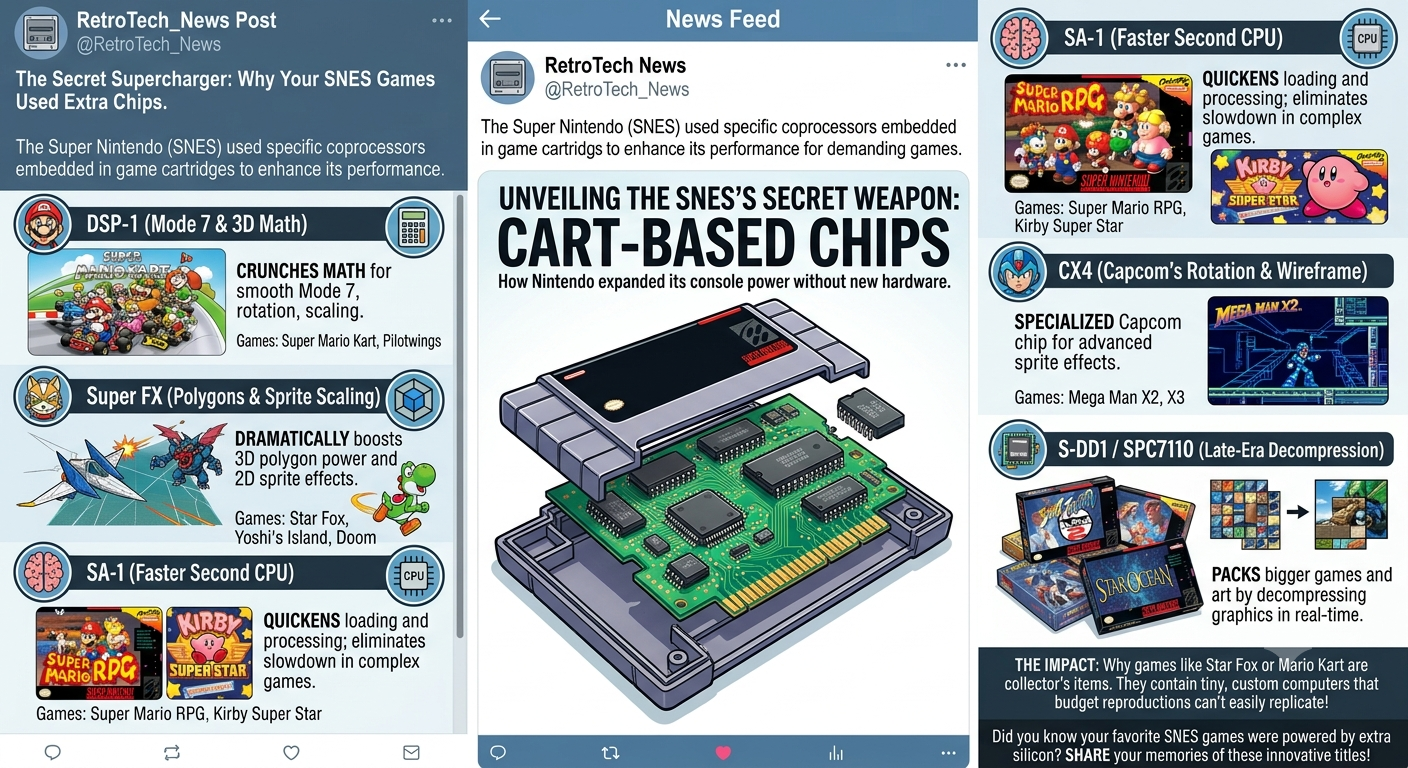
Nintendo’s American 16-bit system — the Super NES, known in Japan as the Super Famicom — had a modest CPU. Instead of launching a mid-cycle hardware refresh, Nintendo and its partners started soldering extra processors onto game boards. Those enhancement chips handled math the main CPU couldn’t keep up with: Mode 7 perspective, polygon drawing, sprite scaling, data decompression, even a real-time clock.
About 13 chip families ended up in roughly 70 commercial games. Most U.S. players never saw the silicon. They just noticed that some games looked like they belonged on a more expensive machine.
Why Nintendo Put Extra Chips in the Cart
The SNES CPU is a 3.58 MHz 65C816-based chip. That’s enough for Super Mario World and The Legend of Zelda: A Link to the Past. It is not enough to draw hundreds of polygons, run tight Mode 7 racing math, or unpack huge late-era graphics packs without hitching.
Cartridge chips solved that without asking families to buy a new deck. Developers paid more per cart. Players paid a few extra dollars at Toys “R” Us or Blockbuster. Nintendo kept the installed base intact. That tradeoff defined the second half of the 16-bit generation in North America.
Think of each chip as a specialist sitting next to the main processor:
Some do 3D and Mode 7 math
Some draw polygons or scale sprites
Some run a faster second CPU
Some unpack compressed art and audio
A few handle odd jobs: sprite lists, calendars, board-game AI
DSP-1: The Chip Behind Super Mario Kart
The first widely used enhancement chip was the DSP-1, a math coprocessor. Despite the name, it is not the SNES sound chip. It crunches the floating-point and trigonometry work that Mode 7 games need for scaling, rotation, and “into the screen” perspective.
What it actually does: the main CPU hands it a calculation — vector, matrix, angle — and reads the answer back. That keeps the race or flight scene from melting when the camera tilts.
Games U.S. players know:
Pilotwings (1991) — first big DSP showcase; the hang-glider and helicopter stages still look clean because the chip is doing the heavy lifting
Super Mario Kart (1992) — the reason Rainbow Road doesn’t fall apart when four players are on screen
Lock On (Japan: Super Air Diver)
Michael Andretti’s Indy Car Challenge
Super Bases Loaded 2 / Super 3D Baseball
Ballz 3D
Later variants existed. DSP-2 appeared only in Dungeon Master. DSP-3 powered Japan’s SD Gundam GX. DSP-4 showed up in Top Gear 3000. Same family, different firmware.
If you only remember one fact: Mario Kart is not “just Mode 7.” Mode 7 is the camera trick. DSP-1 is the calculator that makes the trick hold at 60 frames when your cousin slams the item button.
Super FX: The Chip That Sold Star Fox
The Super FX (also called the GSU, and on the first Star Fox boards the “MARIO” chip) is the celebrity of the lineup. Argonaut Software designed it with Nintendo so the SNES could draw 3D polygons in hardware instead of faking them. Early boards ran around 10.5 MHz. Later GSU-1 and GSU-2 revisions could clock higher and talk to bigger ROMs.
What it actually does: polygon rendering, affine transforms, and — in later games — aggressive 2D sprite scaling and stretching.
Released Super FX games:
| Game | Region notes | Chip generation |
|---|---|---|
| Star Fox (Starwing in Europe) | The poster child | Original MARIO / GSU-1 |
| Stunt Race FX (Wild Trax in Japan) | 3D kart racer | GSU-1 |
| Vortex | Mech shooter | GSU-1 |
| Dirt Trax FX | Snowmobile racer | GSU-1 |
| Dirt Racer | Europe | GSU-1 |
| Doom | Late-life FPS port | GSU-2 |
| Super Mario World 2: Yoshi’s Island | Scaling, rotation, “crayon” effects | GSU-2 |
| Winter Gold | Europe ski game | GSU-2 |
Star Fox 2 was finished, then shelved so it wouldn’t compete with the Nintendo 64 pitch. It finally shipped on the SNES Classic Mini. That cart would have been another Super FX title.
Yoshi’s Island is the sleeper. People assume Super FX only means polygons. Nintendo used the faster GSU-2 for 2D tricks: enemies that squash, stretch, and rotate without the usual SNES shimmer. That’s why the game still looks handmade instead of “16-bit default.”
Doom on SNES is a curiosity more than a killer app — limited enemies on screen, no multiplayer — but it is proof the chip could push a first-person engine on hardware that was never designed for one.
SA-1: A Second, Faster Brain
The SA-1 (Super Accelerator 1) is not a graphics toy. It is another 65C816 CPU running at 10.74 MHz — about four times the console’s CPU — plus extra RAM, extra DMA modes, and a built-in copy-protection CIC. Roughly three dozen games used it, most of them Japan-only board games and strategy titles. A handful mattered in the States.
What it actually does: more CPU time per frame. Bigger maps, less slowdown, denser sprites, faster menu and battle logic.
Games worth knowing:
- Super Mario RPG: Legend of the Seven Stars — Square’s hybrid still feels snappy in battle because the SA-1 is chewing through animation and hit calculations
- Kirby Super Star (Kirby’s Fun Pak in Europe) — minigame swaps stay instant
- Kirby’s Dream Land 3 — late-era animation density
- PGA European Tour
If Super FX is the special-effects unit, SA-1 is the overtime crew. You feel it as “this game doesn’t chug,” not as a new visual gimmick.
CX4: Capcom’s Mega Man Trick
Capcom built the CX4 for two games only: Mega Man X2 and Mega Man X3. It is a math chip aimed at wireframe sequences, sprite rotation, and the kind of flying-fortress set pieces that would have stuttered on a stock cart.
You see it in the intro-style wireframe stages and in some of the larger rotating bosses. It is not a Super FX clone. It is Capcom buying itself a few extra effects without licensing Nintendo’s polygon chip.
S-DD1 and SPC7110: Unpacking Late-Era Games
By 1996, carts were hitting size and cost walls. Two decompression chips showed up so publishers could ship more art without a 32-megabit brick that priced itself off the shelf.
- S-DD1 — real-time graphics decompression. U.S. players met it in Street Fighter Alpha 2. Japan also got Star Ocean, a huge RPG that barely fit the format.
- SPC7110 — decompression plus, in some boards, a real-time clock. Almost entirely a Japanese late-cycle chip (Tengai Makyou Zero / Far East of Eden Zero, Momotaro Dentetsu Happy, Super Power League 4).
These chips do not make new effects. They make bigger games affordable. On original hardware, a bad dump or a cheap flash cart that ignores the chip will give you garbage tiles. That is why accurate emulators spent years catching up.
The Oddballs
A few chips existed for one job and one cart.
- OBC-1 — sprite-list helper in Metal Combat: Falcon’s Revenge, the Battle Clash sequel that used the Super Scope
- S-RTC — a real-time clock in Japan’s Daikaijuu Monogatari II
- ST010 / ST011 / ST018 — SETA’s specialized chips for F1 ROC II: Race of Champions and a pair of competitive shogi games, one of which used an ARM core
You do not need to collect these unless you are building a complete hardware set. They complete the picture: Nintendo let licensees drop in whatever coprocessor the design needed.
What This Meant in American Living Rooms
In the U.S., the chips that mattered were the ones attached to games you could rent on a Friday night:
- DSP-1 made Pilotwings and Mario Kart feel three-dimensional.
- Super FX made Star Fox a Saturday-morning flex and later made Yoshi’s Island look like a storybook.
- SA-1 kept Super Mario RPG and the late Kirby games from slowing down.
- CX4 and S-DD1 were the “Capcom paid extra” tax on Mega Man X sequels and Alpha 2.
That is also why some SNES games still command collector prices. A Star Fox or Yoshi’s Island board is not just ROM and a save battery. It is a tiny custom computer. Reproduction carts and budget flash cards that skip the chip will boot a title screen and then fall apart.
Modern FPGA systems and high-accuracy emulators finally treat these chips as first-class hardware, which is why Star Fox and Mario Kart look “right” again on a living-room TV in 2026. The software was never the whole story. The extra silicon was.
Quick Reference: Chip vs. Job vs. Headline Game
| Chip | Job | Game most Americans recognize |
|---|---|---|
| DSP-1 / 1B | Mode 7 / 3D math | Super Mario Kart, Pilotwings |
| Super FX (GSU-1/2) | Polygons and sprite scaling | Star Fox, Yoshi’s Island, Doom |
| SA-1 | Faster second CPU | Super Mario RPG, Kirby Super Star |
| CX4 | Rotation / wireframe math | Mega Man X2, Mega Man X3 |
| S-DD1 | Graphics decompression | Street Fighter Alpha 2 |
| OBC-1 | Sprite management | Metal Combat: Falcon’s Revenge |
| DSP-4 | Race math variant | Top Gear 3000 |
FAQ
Did every SNES game have a special chip?
No. Most first-party classics — Super Mario World, A Link to the Past, F-Zero, Donkey Kong Country — run on stock hardware. Chips were a late-or-specialty tax.
Is Super Famicom the same as Super Nintendo?
Same generation, different shell, different lockout chip, and a larger Japanese library. Several enhancement-chip games never left Japan.
Why do some ROMs crash in older emulators?
Because the emulator has to simulate the extra chip, not just the console. Super FX, SA-1, S-DD1, and SPC7110 were notorious for incomplete support in the 2000s.
Was this the same idea as the Sega 32X?
Same problem, different philosophy. Sega sold a bulky add-on. Nintendo quietly upgraded the cartridge and kept the living-room box unchanged.
Which chip game should a new collector play first?
Super Mario Kart for DSP-1, Star Fox for Super FX, Yoshi’s Island for Super FX used as a 2D effects card, and Super Mario RPG for SA-1. That set covers the three ideas that actually changed how the SNES felt.
Bottom Line
Nintendo did not wait for the next console to grow the Super NES. It hid extra processors in the plastic shell you already owned. DSP-1 kept Mario Kart honest. Super FX put polygons in a 16-bit living room. SA-1 stopped late RPGs from gasping. The rest of the chips were specialist tools for Capcom, Square, SETA, and a handful of Japanese publishers who needed one more trick before the 32-bit generation took the TV.
The gray deck on the shelf was never the whole machine. For a few dozen games, the real hardware was in the cart.
\ Get the latest news /